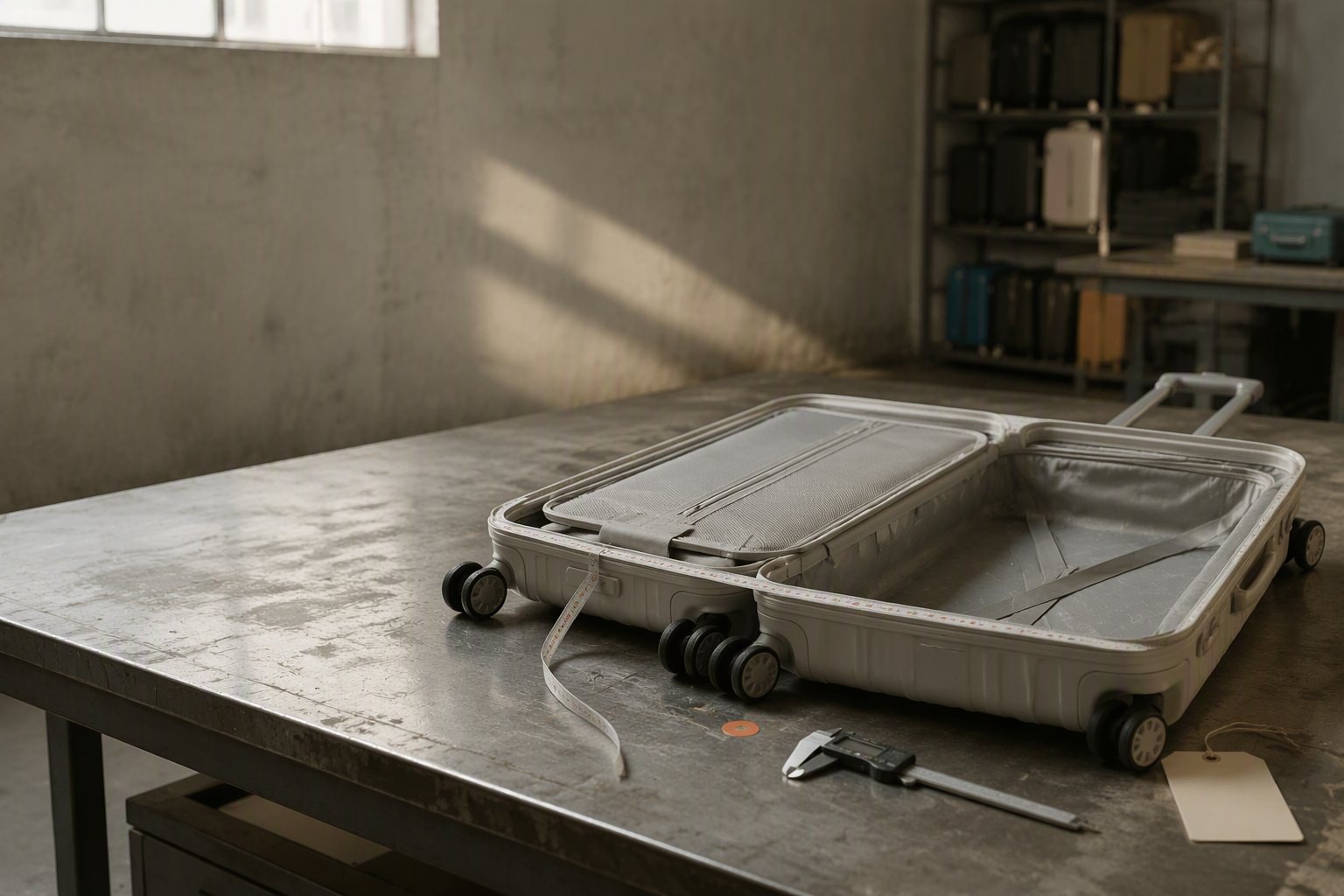
The first sample almost never matches the drawing. That is normal, and it is not a sign you picked the wrong factory. What separates a smooth programme from a stalled one is not whether the first sample is perfect — it is whether you can describe what is wrong precisely enough that the factory can fix it without guessing, and whether you know which changes are cheap and which quietly restart the clock.
This guide is the checklist our own QC team uses when a sample comes back from the sample room, plus the way we handle revisions in writing. Every lead time quoted here is our published figure, not an industry average.
Why the first sample is rarely right
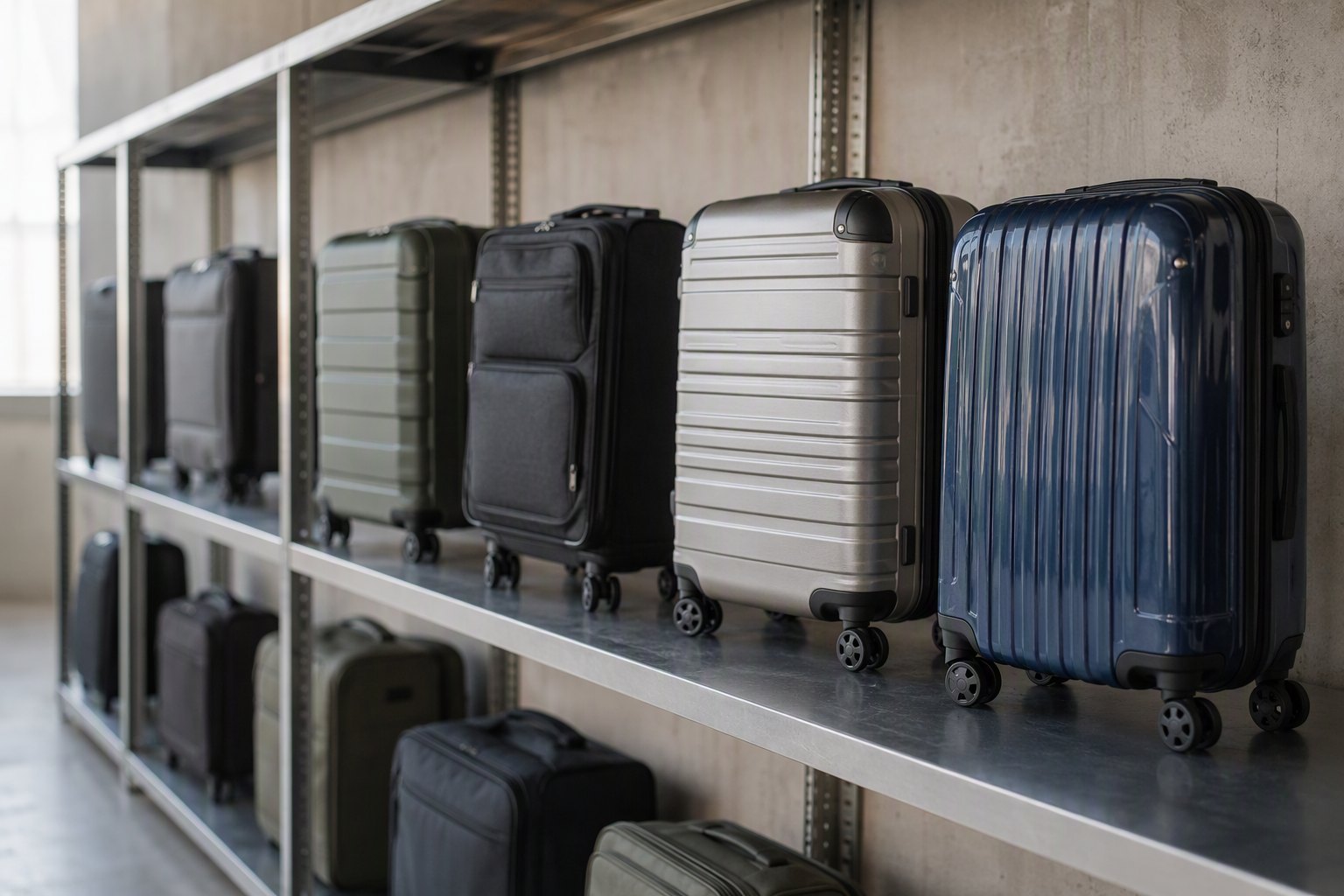
A first sample is produced on a sample line, often with a temporary mould insert, hand-fitted lining, and hardware pulled from stock rather than the production run. Three things routinely differ from the final product:
- Tooling is not final. A sample shell may come off an existing mould that is close but not identical to your file. If your programme needs a new mould, the sample shell and the production shell are two different physical objects.
- Materials are substitutes. Sample rooms often use the nearest available fabric or film in the right colour family rather than your specified article, because ordering a full roll for one sample is not economic.
- Assembly is manual. Sample linings are hand-cut. Production linings are die-cut. Stitch placement and fit tolerance will shift — usually improving, but shifting nonetheless.
So the useful question is not "is this right?" but "which deviations are tooling artefacts that disappear in production, and which are real?" That distinction is exactly what the checklist below is for.
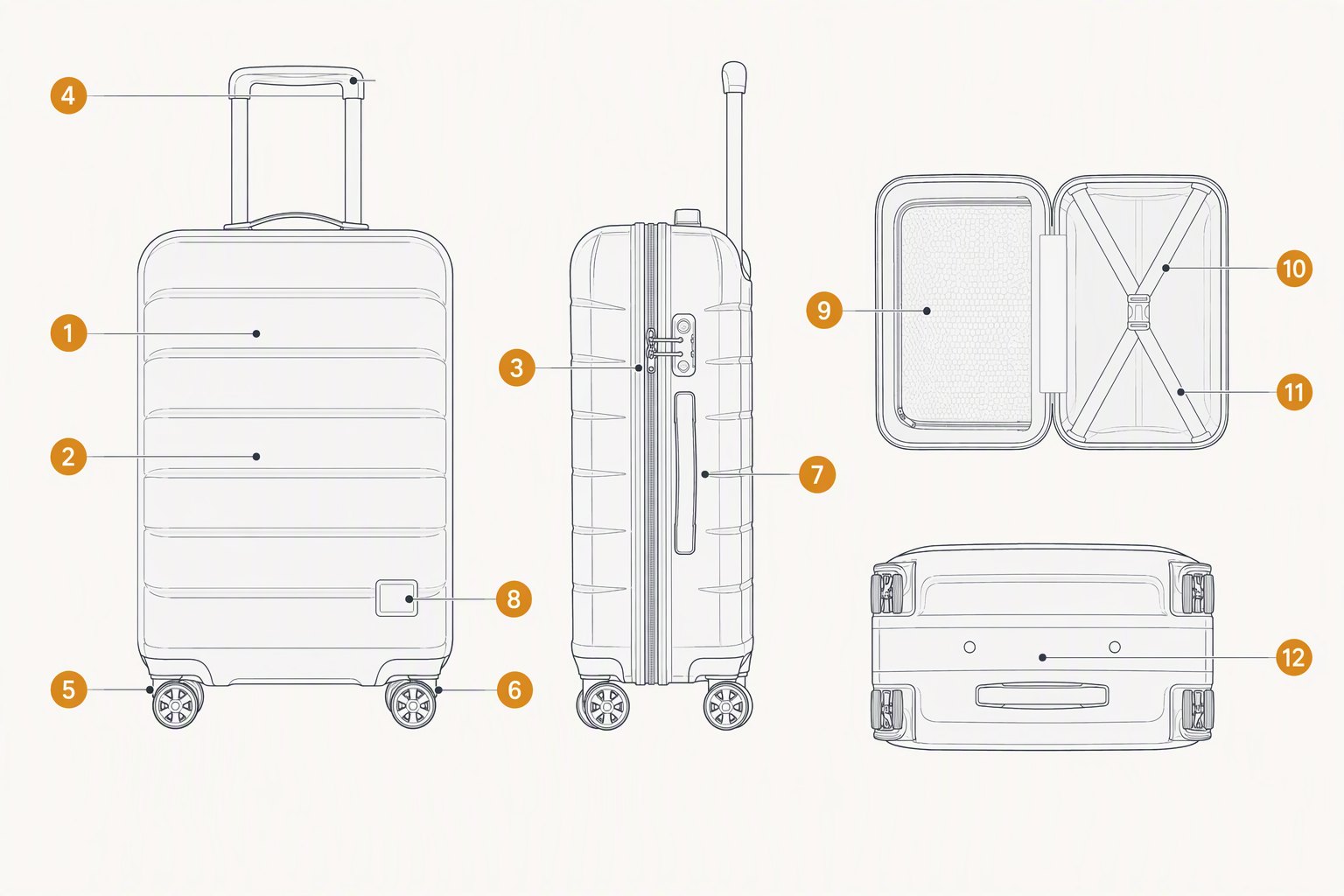
The 12-point first-sample check
Work through these in order. Photograph and measure as you go — a revision brief with numbers closes far faster than one with adjectives.
| # | Check | How to measure | What counts as a defect |
|---|---|---|---|
| 1 | External dimensions | Tape at three points per axis, sample unladen | Any axis outside your stated tolerance; note that published sizes typically exclude wheels and handles |
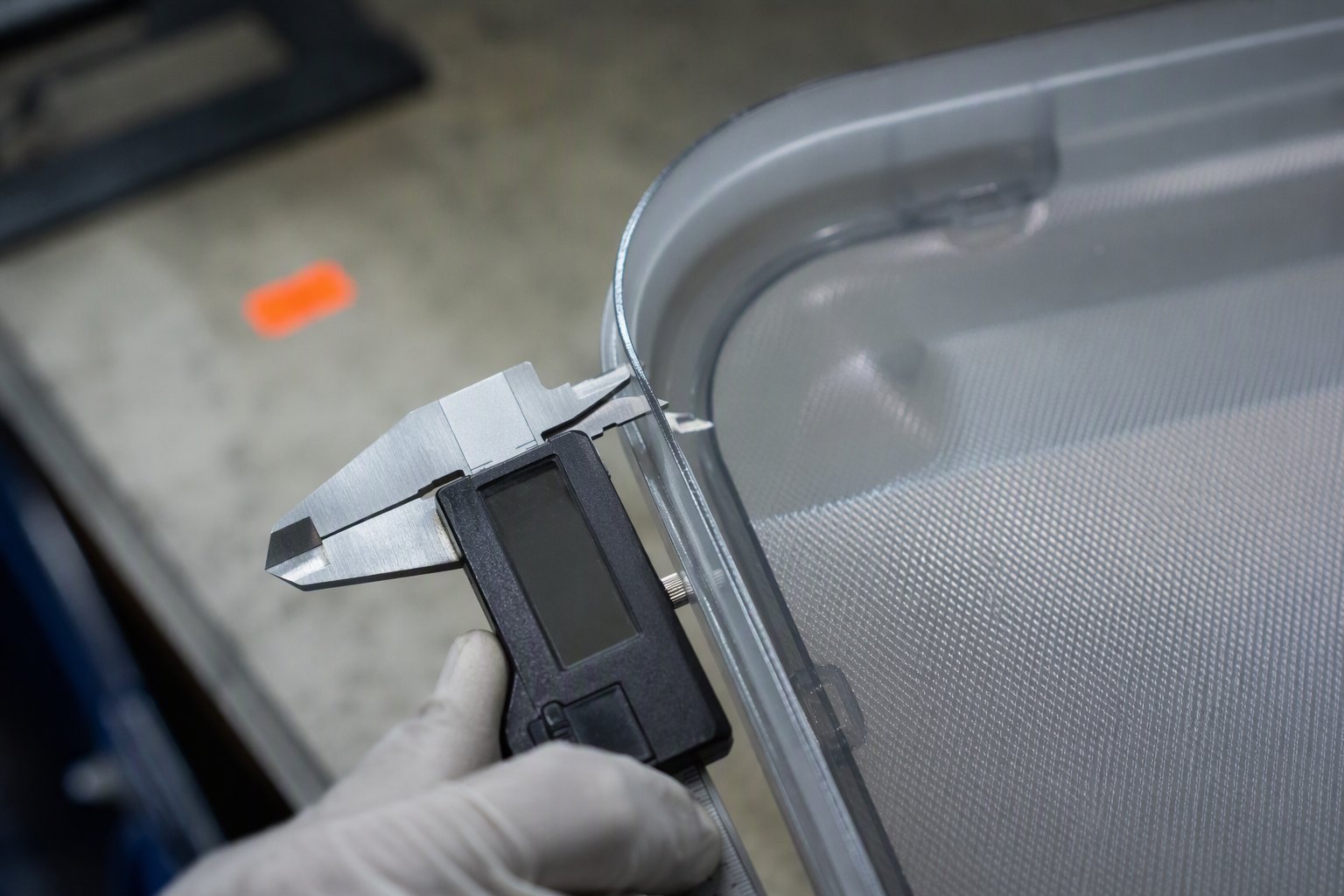
| 2 | Shell wall thickness and bare weight | Ultrasonic gauge if available, otherwise bare weight | Weight below spec by more than 5% suggests a thinner gauge than quoted |
| 3 | Colour against the approved standard | Compare in daylight or a D65 light box, never under factory fluorescent | Visible drift between shell, trim and handle on the same unit |
| 4 | Texture and gloss uniformity | Angle the shell to a light source | Patchy gloss, orange-peel, or texture depth varying across the face |
| 5 | Zip line and pull force | Pull gauge along the full run, both directions | Binding at curves, exposed tape, or a pull force that spikes above the approved figure |
| 6 | Trolley alignment and wobble | Extend fully, apply lateral load at the handle | Visible play at the base, or the handle not returning square |
| 7 | Wheel roll, noise and brake | Loaded run on tile and carpet | Flat spots, rhythmic noise, brake that drags or fails to hold on a slope |
| 8 | Handle strength | Drop cycle to the spec you ordered — we build to either a 500-cycle or a 200-cycle handle standard | Any cracking at the anchor, or permanent deformation after the cycle count |
| 9 | Lining fit and stitching | Open fully, inspect seams and corners | Puckering at corners, skipped stitches, loose thread, lining short of the frame |
| 10 | Logo position, method and registration | Measure from a fixed datum, not by eye | Off-centre by your tolerance, wrong process, or edge lift on the transfer |
| 11 | Internal structure and hardware engagement | Fit a real load: straps, buckles, dividers | Buckle that releases under load, strap that will not tension, divider that fouls the zip |
| 12 | Packing, carton mark and gross weight | Weigh the packed carton | Gross weight materially above the quoted figure, or carton mark not matching your artwork |
Two of these deserve emphasis because they are the most commonly skipped. Colour check (3) must happen in daylight. A shell that matches under sodium factory lighting can be two shades off outdoors, and colour is the single most expensive thing to correct after mass production starts. Gross weight (12) matters even if you never open the carton: it feeds directly into your freight cost, and a heavy carton quietly erodes margin on every unit you ship.
Revision, or new requirement?
This is the distinction that decides whether your timeline survives. A revision corrects the sample toward the specification you already approved. A new requirement changes the specification itself. Factories price and schedule them completely differently, and confusing the two is where most friction comes from.
| Change you ask for | What it actually is | Consequence |
|---|---|---|
| Colour drifts from the approved standard on our side | Revision | Our cost. Re-run the sample. |
| Move the logo 5 mm to align with the trim | Revision | Usually no charge; the plate already exists |
| Add a second internal pocket | New requirement | New lining pattern, new sample, new approval round |
| Switch shell texture from lychee to diamond grain | New requirement | New mould or new printed film — this can be the largest single cost in the project |
| Change zipper brand from a house brand to a premium brand | New requirement | Re-quote, re-test, and a longer material lead time |
| Tighten a dimensional tolerance you previously accepted | New requirement | Possibly new tooling. A tolerance is a manufacturing decision, not a preference |
Notice the pattern: anything that touches a mould, a printed film, or a purchased component is a new requirement. Anything that adjusts how an existing approved part is applied is a revision. If you internalise only one rule from this article, make it that one — it predicts the cost and the delay before you even ask.
How to write a revision brief a factory can execute
A brief is not a complaint. It is a work instruction. The difference is measurable: briefs with a location, a measurement, and a proposed fix close in one round. Briefs with adjectives come back wrong, and each round costs another sample cycle.
| What not to write | What to write instead |
|---|---|
| "The handle feels cheap." | "Handle: at the base anchor, lateral movement measures about 3 mm under a 20 kg static load. Add a reinforcing rib at the base and re-test to the 500-cycle standard." |
| "The colour is wrong." | "Shell reads approximately one shade darker than the approved standard when compared in daylight. Trim and handle match each other but not the shell. Re-match the shell to the approved standard and send a colour chip before rebuilding." |
| "The zipper is stiff." | "Zip pull force peaks around the top curve on the left side; the run is smooth elsewhere. Check tape alignment at that curve and confirm whether the slider is the specified size." |
| "Interior looks unfinished." | "Lining puckers at both bottom corners, roughly 8 mm of excess material. Corners are hand-cut on the sample; please confirm the production die removes this." |
Three habits make the biggest difference. Number every point so the factory can reply point by point and nothing is silently dropped. Attach a photo with the defect circled and a scale reference — a ruler or a coin in frame removes all ambiguity about size. State what you want done, not only what is wrong: "add a rib", "re-match the chip", "confirm the die". A factory can act on an instruction; it can only guess at a verdict.
Closing in two rounds
Three rounds is the normal pattern for a custom programme, and most well-run projects close in two. The way to get there is to treat round one as a full pass: check everything on the list before you send it, rather than sending the three things you noticed first and discovering the rest a cycle later.
Round two should contain only the corrections from round one, plus anything that genuinely could not be assessed until round one was fixed. If round two contains new points that were visible in round one, the timeline will slip — not because the factory was slow, but because the scope moved after work had already restarted.
What round two should not contain: new features, new materials, or a tightened tolerance. Those belong in a new sample, and a new sample is a new cycle. Keeping them out of round two is the single most effective thing you can do to protect your launch date.
The 7–15 day sample clock, and the four things that break it
A standard sample runs 7–15 days. A fully custom design runs 20–30 days. Where an existing mould already exists — we hold more than 200 mature suitcase moulds — an expedited sample can ship in 5 days.
Those numbers are for the sample itself. The reason timelines surprise buyers is that some components carry their own customisation clock that runs before the sample can be built:
| Component | Mould | Custom colour | Custom logo or print |
|---|---|---|---|
| Wheel | 30 days | 7–15 days | — |
| Trolley button | 30 days | 7–15 days | — |
| Lock | 30 days | 7–15 days | — |
| Trolley tube | — | 7–15 days | 30 days |
| Lining | — | — | 15–20 days |
| Inner label | — | — | 5–10 days |
| X-shaped strap | — | — | 7–15 days |
| Shell, handle, buckle, zip puller | 7–15 days | 7–15 days | 7–15 days |
So a project that puts your logo on the wheels is not a 7–15 day sample. It is a 30-day tool plus the sample. The same applies to a custom lock or a custom trolley button. If your target date depends on a sample, check this table before you commit to it — the cost of a bespoke wheel or lock is not only the tool, it is the month.
One more planning note: if your destination requires azo compliance, the test covers the zip, leather strap, lining, webbing and elastic, binding strip and snap fasteners as a set. It is far cheaper to design those components to a compliant source from the start than to re-source them after a failed test.
What we charge for a revision, and what we do not
Most factories leave this vague, and the vagueness works against the buyer, because "we will look after you" is not a policy you can plan around. Ours is written down:
- If an aluminium mould has already been cut, and the change is the client's subjective decision — for example a colour you now prefer, a logo you want moved, a shape you want slimmer — the revision is chargeable, because the tooling has to be re-made.
- If the deviation is our design error — the sample does not match the drawing we both approved — the revision is at our cost.
- Three rounds is the normal path to a locked design.
That split is the reason the "revision or new requirement" question earlier matters so much. The moment a mould is cut, a subjective change becomes an engineering change, and it is priced accordingly. Before the mould is cut, the same change is usually absorbed in the next sample.
Photo and video protocol before the sample ships
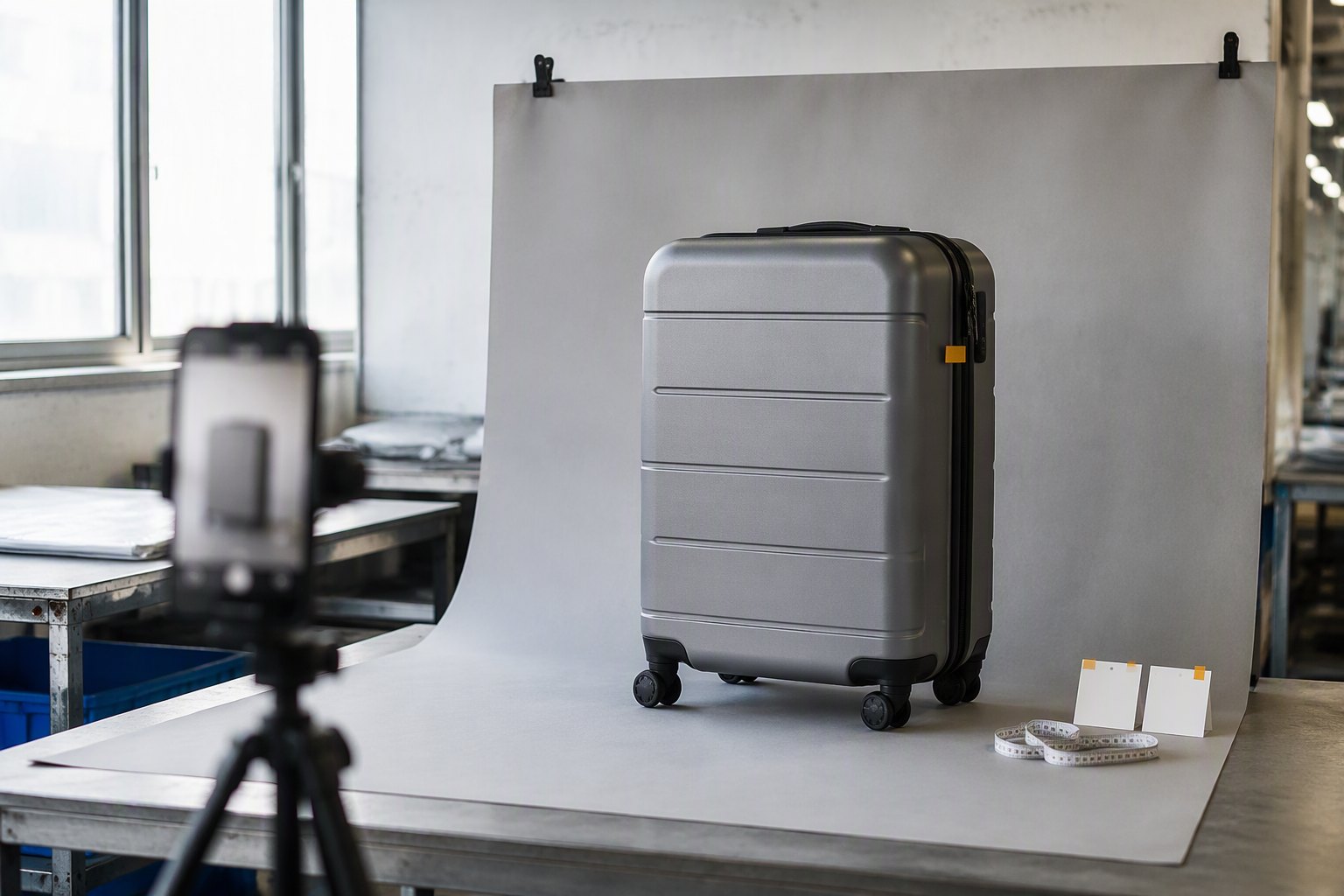
Most sample problems are visible before the carton is sealed. Ask for a fixed set of images before dispatch, and you will catch them without paying for a round trip:
- Six views on a plain background: front, back, both sides, top, base — with the unit standing, not lying down
- One close-up of each logo location, shot square-on, with a scale reference
- One shot inside both compartments, fully open, evenly lit
- The trolley at full extension, taken side-on so any lean is visible
- A 20-second video rolling the loaded unit across tile, then carpet, then a kerb transition
- The packed carton, showing the mark and the label positions
Video matters more than people expect. A photograph cannot show a wheel that rolls true but sounds wrong, or a trolley that returns square but shudders under load. Those two faults account for a large share of complaints and neither is visible in a still.
The documents behind the testing described here — the 2026 amfori BSCI summary, the REACH and RoHS reports for the materials we test, and our ISO 9001, 14001 and 45001 certificates — are collected on the factory evidence page. The production figures quoted above are documented on the factory facts page.
Frequently asked questions
How long does a luggage sample take?
7–15 days for a standard sample, 20–30 days for a fully custom design. If a suitable mould already exists, an expedited sample can ship in 5 days. Any component that needs its own tool — wheel, lock, trolley button, or a logo etched on the trolley tube — adds its tooling time before the sample can be built.
Do you charge for revisions?
If an aluminium mould has already been cut and the change is a client's subjective decision, the revision is chargeable. If the sample deviates from the drawing we both approved, it is at our cost.
How many revision rounds does it usually take to lock a design?
Three rounds is the normal path. Most well-run projects close in two, provided the first pass covers the whole checklist rather than only the most obvious faults.
Can I approve a sample from photos and video?
For small changes yes, and for repeat models yes. For a first sample of a new mould we recommend physical approval, because colour, texture and hardware feel do not survive a screen. If time is tight, approve the photographs and hold mass production start until the physical unit lands.
What if mass production does not match the approved sample?
The approved sample is the reference, and deviations are measured against it. That is why the sample should be signed, dated, and kept by both sides. Our published on-time delivery rate is 95%, and matching the approved sample is a separate commitment that we hold to independently of the schedule.
Can I test the sample with my own laboratory?
Yes, and for regulated markets you usually should. Your own lab report is stronger evidence in your market than ours, and a failed test caught at sample stage is a design change rather than a shipment problem.
For the wider schedule this fits into, see the complete production timeline and what actually happens in those weeks. If you want to know what a sample costs in the context of the whole order, our cost breakdown from mould fees to mass production sets out where the money goes. For how we inspect a finished production run, see the seven factory tests and what standard we inspect against. The documents behind these claims are collected on our factory evidence page.