
If you are buying luggage from China, the standard your factory is actually inspected against is QB/T 2155-2018 — and the first thing to understand is what it is not. It is not a national standard. It is not mandatory. It is a recommended light-industry standard, issued by the Ministry of Industry and Information Technology, and it has replaced its own 2010 and 2004 editions. Almost every third-party lab in China tests luggage against it, and almost every serious buyer writes it into the purchase order — but a supplier who tells you its luggage is "GB-certified" or "internationally certified" is using words that do not correspond to any document.
This article lays out exactly what QB/T 2155-2018 is, all 22 test items a lab will run against it, the separate standard series that governs the parts (wheels, handles, locks, zips, aluminium frames), which items are genuinely mandatory rather than recommended, and what the rest of the world actually uses — including two ASTM numbers that circulate in luggage test reports and belong to a completely different industry.
The Direct Answer
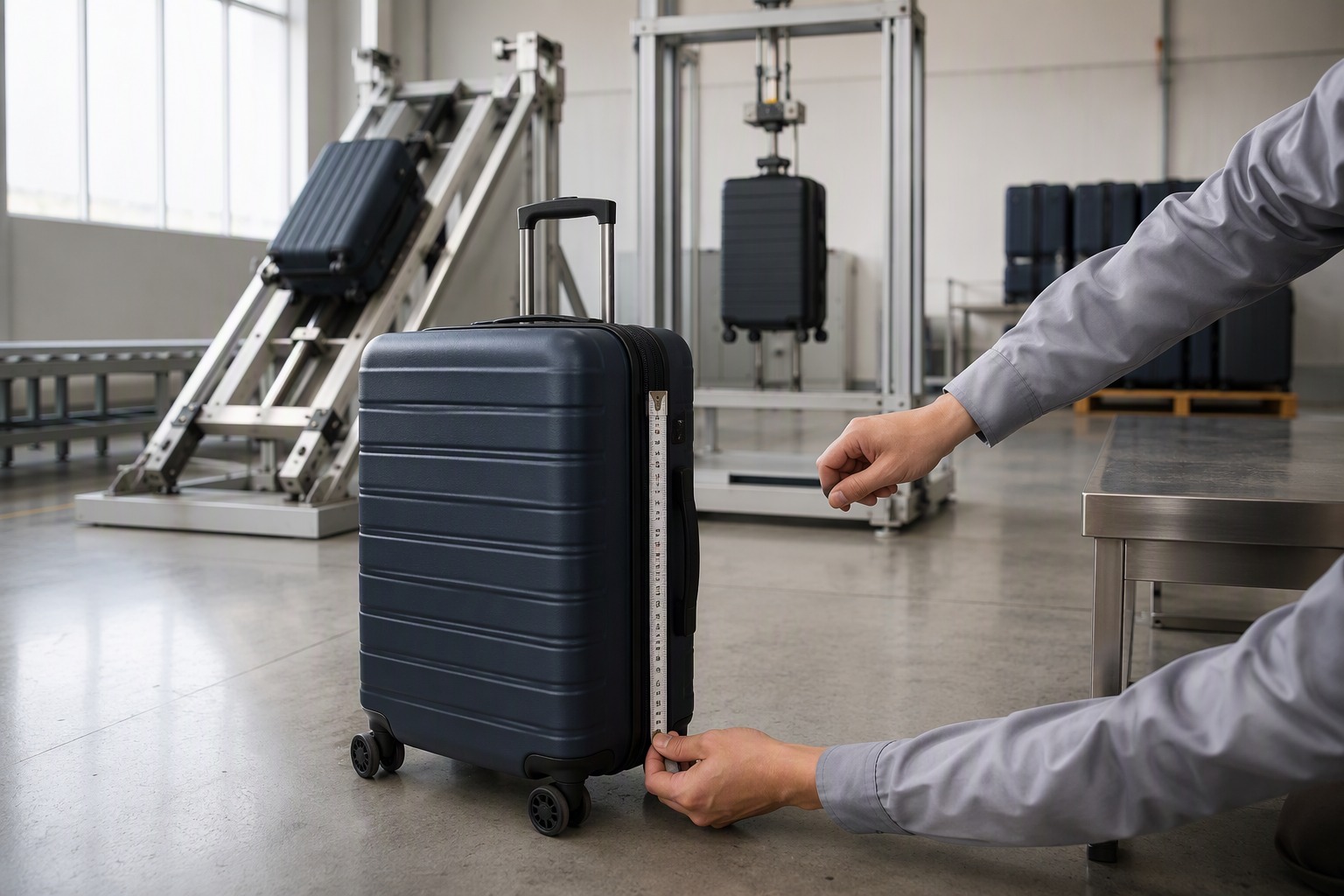
For luggage sold into the Chinese market, inspection runs against QB/T 2155-2018《旅行箱包》 (Travelling case and trolley bag) — a recommended (recommended = tuijianxing) light-industry standard, published 8 May 2018 and effective 1 September 2018, wholly replacing QB/T 2155-2010. The parts that go into a suitcase are covered by a separate series, QB/T 1586.1 to 1586.5, plus QB/T 2917-2007 for wheel abrasion testing. Of everything in scope, only free formaldehyde and decomposable carcinogenic aromatic amine dyes are treated as mandatory in official Chinese market-supervision sampling; the remaining items are recommended.
Outside China there is no single product standard for luggage to point at. The EU and the US regulate luggage through chemical and product-safety law rather than a luggage standard, Japan works through its Household Goods Quality Labelling Act plus JIS and individual company specifications, and ISO currently has no luggage product standard at all under the classification that covers trunks and suitcases.
What QB/T 2155-2018 Actually Is
Every field below is taken from the official Chinese standards platforms (the light-industry standards platform at hbba.sacinfo.org.cn and the national standards platform at std.samr.gov.cn), not from a summary article.
| Field | Value |
|---|---|
| Standard number | QB/T 2155-2018 |
| Chinese title | 旅行箱包 |
| Nature | Industry standard — QB (light industry) — recommended, not mandatory |
| Status | In force (现行) |
| Published | 8 May 2018 |
| Effective | 1 September 2018 |
| Replaces | QB/T 2155-2010 in full |
| Approved by | Ministry of Industry and Information Technology |
| Administered by | National Technical Committee for Leather Industry Standardization |
| Chinese classification (CCS) | Y48 |
| International classification (ICS) | 59.140.35 — Leather products |
| Registration number | 63690-2018 (registered 24 May 2018) |
One calibration note worth knowing, because it will come up if a buyer and a supplier compare printouts: the same official platform's list view shows the approval date as 7 May 2018 and the effective date as 31 August 2018, while the detail page shows 8 May and 1 September. The two differ by one day. The detail page is the record to quote.
The Replacement Chain: Three Editions, One Live
QB/T 2155 has been revised twice. Both earlier editions are formally withdrawn, so a purchase order that still cites 2010 or 2004 is citing a dead document.
| Edition | Status | Published | Effective | Replaced |
|---|---|---|---|---|
| QB/T 2155-2018 | In force | 8 May 2018 | 1 Sep 2018 | QB/T 2155-2010 |
| QB/T 2155-2010 | Withdrawn | 29 Dec 2010 | 1 Apr 2011 | QB/T 2155-2004 |
| QB/T 2155-2004 | Withdrawn | 15 Aug 2004 | 1 Jan 2005 | QB/T 2155-1995 and QB/T 2156-1995 |
The chain matters commercially for one reason: an ageing specification sheet often survives into a new season by copy-paste. If your technical file says 2010, your supplier is entitled to test to 2010.
All 22 test items a laboratory will run
QB/T 2155-2018 is a copyrighted document, so its text is not republished here. What follows is the item list as published by CTI (Centre Testing International), one of China's largest testing houses, on its luggage testing service page, where the standard is named explicitly as the applicable product standard. Treat this as a laboratory's reading of the standard — the coverage, not the clause numbers or the pass limits.
| # | Item | Group |
|---|---|---|
| 1 | Specification (规格) | Identity |
| 2 | Restricted substances: free formaldehyde, decomposable carcinogenic aromatic amine dyes, adhesives used in the case | Chemical |
| 3 | Case lock (箱包锁) | Parts |
| 4 | Wheels (走轮) | Parts |
| 5 | Carrying handle (提把) | Parts |
| 6 | Telescopic handle / trolley (拉杆) | Parts |
| 7 | Hardware fittings (五金配件) | Parts |
| 8 | Zip fastener (拉链) | Parts |
| 9 | Appearance quality (外观质量) | Appearance |
| 10 | Marking and labelling (标识标志) | Identity |
| 11 | Telescopic handle fatigue resistance | Mechanical |
| 12 | Travelling performance (walking/rolling test) | Mechanical |
| 13 | Shaking impact performance | Mechanical |
| 14 | Drop performance | Mechanical |
| 15 | Static compression resistance of hard case body | Mechanical |
| 16 | Falling-ball impact resistance of plastic hard case surface | Mechanical |
| 17 | Drum/tumbler impact performance | Mechanical |
| 18 | Case lock durability | Mechanical |
| 19 | Hardness of aluminium case frame | Material |
| 20 | Seam strength | Mechanical |
| 21 | Rubbing fastness (colour fastness to rubbing) | Material |
| 22 | Corrosion resistance of hardware fittings | Material |
Cross-checking that list against the fourteen items named in the Beijing Municipal Market Supervision Administration's 2019 sampling plan for luggage and bags — an official government document that also names QB/T 2155 as the standard to test against — eleven items appear in both. The government plan adds fabric rubbing fastness for travel bags; the laboratory list adds specification, marking, case lock, wheels, handle, trolley, hardware, zips, aluminium frame hardness, rubbing performance and hardware corrosion resistance. The two describe the same scope in different granularity: identity and appearance, eight structural/mechanical items, four to six parts items, and two to three chemical items.
The item-level test methods behind the names
Each mechanical item above is executed under its own dedicated method standard. If you are writing a QC protocol, these are the numbers to cite — they are the actual procedures, not the product standard.
| Test item | Method standard |
|---|---|
| Travelling / rolling | QB/T 2920-2018 箱包 行走试验方法 |
| Telescopic handle fatigue | QB/T 2919-2018 箱包 拉杆耐疲劳试验方法 |
| Shaking impact | QB/T 2922-2018 箱包 振荡冲击试验方法 |
| Drum / tumbler | QB/T 4116-2023 箱包 滚筒试验方法 |
| Falling-ball impact on hard case surface | QB/T 2918 落锤冲击试验方法 |
| Wheel abrasion | QB/T 2917-2007 箱包五金配件 走轮耐磨试验方法 |
| Volume ratio measurement | QB/T 5083-2017 箱包 容积率的测定 |
| Fastener testing | QB/T 5084-2017 箱包 扣件试验方法 |
| Plastic buckle durability | QB/T 5247-2018 箱包配件 塑料插扣耐用性能试验方法 |
Note the years. Several of these method standards were revised after the product standard: the travelling, handle-fatigue, shaking-impact and drum methods now carry 2018 and 2023 editions. A test report that cites a 2007 method standard is not wrong, but it is testing to a superseded procedure.
Which items are actually mandatory
This is the part most buyers get wrong. Within QB/T 2155 the great majority of items are recommended. In official Chinese market-supervision sampling, only two chemical items are handled as compulsory — and even then, the route depends on the material:
| Item | Treatment in official sampling | Route |
|---|---|---|
| Free formaldehyde | Compulsory | Leather and regenerated-leather materials: GB 20400. Textile materials: QB/T 2155 or the declared product standard. |
| Decomposable carcinogenic aromatic amine dyes | Compulsory | Same split as above. |
| All structural, parts and appearance items | Recommended | — |
The practical consequence: a supplier cannot be prosecuted for failing a drum test, but can be for failing formaldehyde. That does not make the mechanical items optional in commercial terms — they are the ones that generate warranty returns — only that their force comes from your purchase order, not from the standard's own status.
The parts side: QB/T 1586 and friends
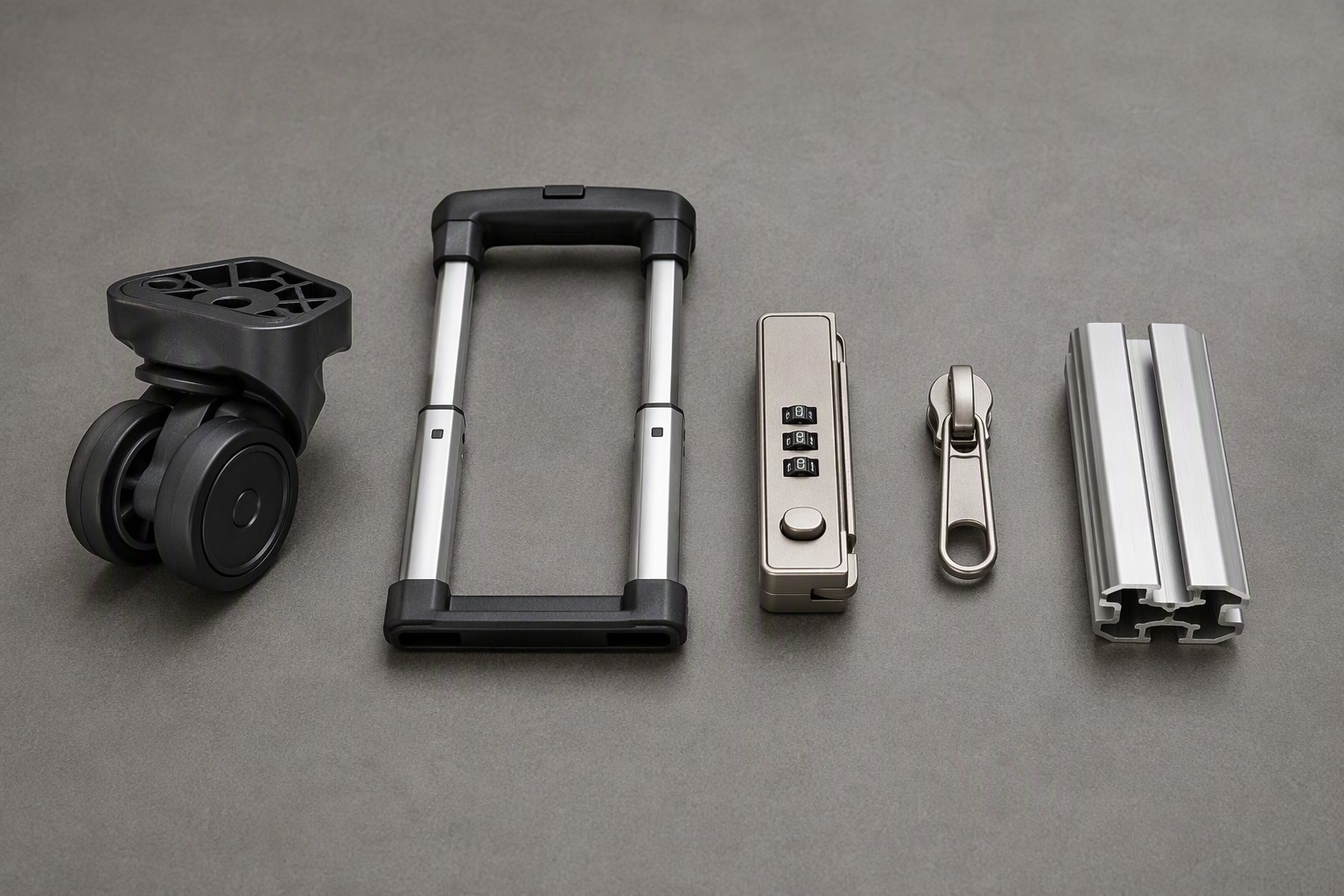
Wheels, handles, locks and frames are not defined inside QB/T 2155 in engineering detail. They have their own series, verified item by item on the official platform.
| Standard | Covers | Published / effective |
|---|---|---|
| QB/T 1586.1-2010 | 箱包五金配件 箱锁 — case locks | 29 Dec 2010 / 1 Apr 2011 |
| QB/T 1586.2-2010 | 箱包五金配件 箱走轮 — case wheels | 29 Dec 2010 / 1 Apr 2011 |
| QB/T 1586.3-2010 | 箱包五金配件 箱提把 — carrying handles | 29 Dec 2010 / 1 Apr 2011 |
| QB/T 1586.4-2010 | 箱包五金配件 箱用铝合金型材 — aluminium alloy profiles for cases | 29 Dec 2010 / 1 Apr 2011 |
| QB/T 1586.5-2010 | 箱包五金配件 拉杆 — telescopic handles | 29 Dec 2010 / 1 Apr 2011 |
| QB/T 2917-2007 | 箱包五金配件 走轮耐磨试验方法 — wheel abrasion test method | 3 Dec 2007 / 1 Jun 2008 |
There is a detail in this table that repays attention. The 1992 edition of the series had four parts — locks, wheels, handles and aluminium profiles. The telescopic handle, part .5, was only given its own standard in the 2010 revision. Before that, the trolley had no standalone parts standard to be bought against. If you are writing a specification today, .5 is the one to quote for handle quality, because it is the youngest document in the series and the one that reflects the modern multi-stage trolley.
The global map: what the rest of the world actually uses
Buyers routinely ask for a "CE certificate" or an "ISO luggage standard". Neither exists as a luggage-specific document. What follows is what each market really runs on, verified against official sources.
| Market | What actually governs luggage | Is there a luggage product standard? |
|---|---|---|
| China (mainland) | QB/T 2155-2018 for the product; QB/T 1586 series for parts; GB/T 41002-2022 also cited by laboratories | Yes — an industry standard, recommended |
| Taiwan region | CNS 15331 袋、包及箱產品評估準則 — adopted by the Bureau of Standards, Metrology and Inspection as the inspection standard, covering load, telescopic handle function, walking and drop tests | Yes |
| European Union | Chemical and product-safety law: REACH, POPs, packaging rules; EN 71 additionally for children's luggage | No — no confirmed luggage product standard |
| United States | CPSIA, California Proposition 65, 16 CFR provisions, plus ASTM material and component methods; children's luggage adds ASTM F963 | No — law plus component methods |
| Japan | Household Goods Quality Labelling Act (textile goods quality labelling regulations, "kaban" section), the Premiums and Representations Act, JIS specifications and individual company specifications. JIS S 3015 covers slide fasteners. | No single product standard; a labelling law plus JIS plus company specs |
| International (ISO) | ISO/TC 120 leather standards; ISO 2248 is a transport-packaging drop test used by some labs for luggage | No — the ISO classification covering trunks and suitcases lists only one standard, and it is a leather-goods classification guideline, not a luggage standard |
The ISO point is worth stating precisely because it is so often misrepresented. Under ICS 59.140.35, the classification whose own scope names trunks, suitcases and handbags, the ISO catalogue currently carries a single entry: ISO 18270:2026, a classification and performance guideline for leather upholstered products. There is no ISO luggage standard to be certified against.
Two ASTM numbers that do not mean what they look like
Luggage test reports and supplier spec sheets occasionally cite ASTM standards as evidence of international quality. Two of them are worth knowing by heart, because they are provably from another industry:
| Cited as | What the number actually is |
|---|---|
| ASTM F1839 — "luggage/backpack testing" | Standard specification for rigid polyurethane foam used as a standard material for testing orthopaedic devices and instruments |
| ASTM F2028 — "caster abrasion" | Standard test methods for dynamic evaluation of glenoid loosening or disassociation — a shoulder-joint implant test |
Neither has anything to do with luggage. One of them concerns foam for orthopaedic test rigs; the other concerns shoulder prosthetics. When a document cites either as luggage evidence, the rest of that document deserves the same level of scrutiny.
By contrast, ASTM D2061 (zipper strength tests — transverse strength of the chain, top-stop strength, slider attachment strength) is a genuine fastener method sometimes used on luggage zips, and is legitimate to cite as a component test.
A local tightening worth knowing: the Xin'gan cluster standard
Industry standards are floors, not ceilings, and the cluster CLK manufactures in — Xin'gan County in Jiangxi Province — has written its own group standard on top of QB/T 2155. Under T/XGXB, the group standard for Xin'gan luggage, several performance indicators are set stricter than the industry standard: travelling performance, drop performance, static compression resistance of the hard case body, falling-ball impact resistance of the plastic case surface, and drum impact performance. It also adds requirements the industry standard does not carry at all — zip testing indicators, rubbing colour fastness for the case lining, and weatherability.
That is the useful shape of the market: the national industry standard defines what can be sold, and a producing cluster's own standard can define what a serious factory in that cluster is willing to put its name to. If you are already buying from a Jiangxi supplier, it is a fair question to ask which group standard they test against and whether the report cites it.
What to write into your purchase order
Turning the above into one page of specification does not take long. Five lines cover most of the risk:
- Product standard: QB/T 2155-2018, or the declared product standard, named with its year.
- Method standards: the specific method numbers for the mechanical tests you care about — travelling (QB/T 2920-2018), handle fatigue (QB/T 2919-2018), shaking impact (QB/T 2922-2018), drum (QB/T 4116-2023).
- Parts standards: QB/T 1586.5 for the trolley, 1586.2 for wheels, 1586.1 for locks, 1586.4 for aluminium profiles, plus QB/T 2917-2007 for wheel abrasion.
- Chemical: free formaldehyde and decomposable carcinogenic aromatic amine dyes, with the material route named (GB 20400 for leather, product standard for textiles).
- Sampling and acceptance: the standard itself does not publish a sample size and acceptance rule for luggage that a buyer can simply quote; that is a commercial term you and the supplier have to agree and write down.
That last point is the one buyers most often assume away. Because QB/T 2155's own sampling quantity and acceptance criteria are not publicly republished by the laboratories, the honest position is that the buyer specifies them. If your specification is silent, you have not agreed a rejection rule — you have agreed to argue later.
Frequently Asked Questions
Is QB/T 2155-2018 mandatory in China?
No. QB/T 2155-2018 is a recommended light-industry standard. It becomes binding on a supplier only when your purchase order or sales contract names it. The two items enforced in official market-supervision sampling — free formaldehyde and decomposable carcinogenic aromatic amine dyes — are compulsory, but their legal force comes from the material regulations and the sampling regime, not from QB/T 2155's own status.
Can I ask for a "CE certificate" for luggage?
Not meaningfully. CE marking is not a single certificate and there is no EU luggage product standard behind it. Luggage entering the EU is regulated through chemical and product-safety law — REACH, POPs, packaging rules, and EN 71 where children's products are involved. What a supplier can give you is test reports against those regulations, not a piece of paper called a luggage CE certificate.
Do I need an ISO certificate for luggage?
There is no ISO luggage product standard to be certified against. ISO's classification for leather products, which explicitly names trunks and suitcases, currently lists one standard, and it is a classification and performance guideline rather than a luggage standard. ISO 9001 tells you about a factory's quality management system, not about the suitcase.
Why do test reports cite different years for the same test?
Because the product standard and the method standards are revised on separate cycles. A report may cite QB/T 2155-2018 as the product standard while using a 2007 edition of a method standard. Neither citation is dishonest, but only one of them reflects the current procedure — so ask the laboratory to name the year of every standard it applied.
About the Author
Written by the compliance and engineering team at Jiangxi Chengleke Leather Co., Ltd (CLK Luggage), a luggage manufacturer in Xin'gan County, Jiangxi Province. We build hard-shell, aluminium-frame and soft luggage for B2B buyers, and we prepare test documentation for each order against the product, method and parts standards named above. If you would like the standard list written into a technical confirmation sheet for your next order, send us the specification and we will return it annotated.
Related Products & Sourcing
- How luggage is tested: the factory tests your suitcase should pass before shipping
- Verifying a luggage supplier: certificates, test reports and the audit trail
- Luggage certification checklist for importers and brand owners
- QB/T 1586 series: the parts standard skeleton behind wheels, handles, locks and trolleys
Sources. Standard identity, dates, replacement chain and status: hbba.sacinfo.org.cn and std.samr.gov.cn official standard platforms (verified 8 October 2026). Fourteen inspection items, mandatory/recommended treatment and material routing: Beijing Municipal Market Supervision Administration, 2019 sampling plan for bags and luggage, scjgj.beijing.gov.cn. Twenty-two-item laboratory list: CTI (Centre Testing International) luggage and trolley-case testing service page, cti-cert.com, where QB/T 2155-2018 is named as the applicable product standard. Parts series and method standards: official standard platform detail pages, verified item by item. Group standard T/XGXB tightening indicators: China group-standards platform, ttbz.org.cn. International positions: ISO classification page for ICS 59.140.35, iso.org; IATA cabin baggage guidance; testing-house national capability tables for EU and US scopes. ASTM F1839 and F2028 titles: ASTM/ANSI catalogue entries.