
Almost every suitcase that comes back from a trip smells for the same three reasons, and only one of them is the shell. The shell wipes clean in ten seconds. The smell comes from the lining, from behind the lining, and from the wheel housings. So before you buy another deodorizer, know which one you are dealing with: a surface that needs wiping, a layer that needs drying, or hardware that needs picking clean.
This guide is written from our side of the factory. We make hard shell, soft shell and aluminum frame luggage, which means we also see the maintenance complaints that come back years later. The routine below is the one we would give a customer, and at the end there is a section for brands and importers, because two of these problems are decided in the specification, not in the bathroom.
Why Your Suitcase Smells After a Trip, and Why Airing It Out Is Not Enough
Open the case, unzip it fully, and leave it in the corner of a room for a day. The surface of the lining will feel dry. The smell often stays anyway.
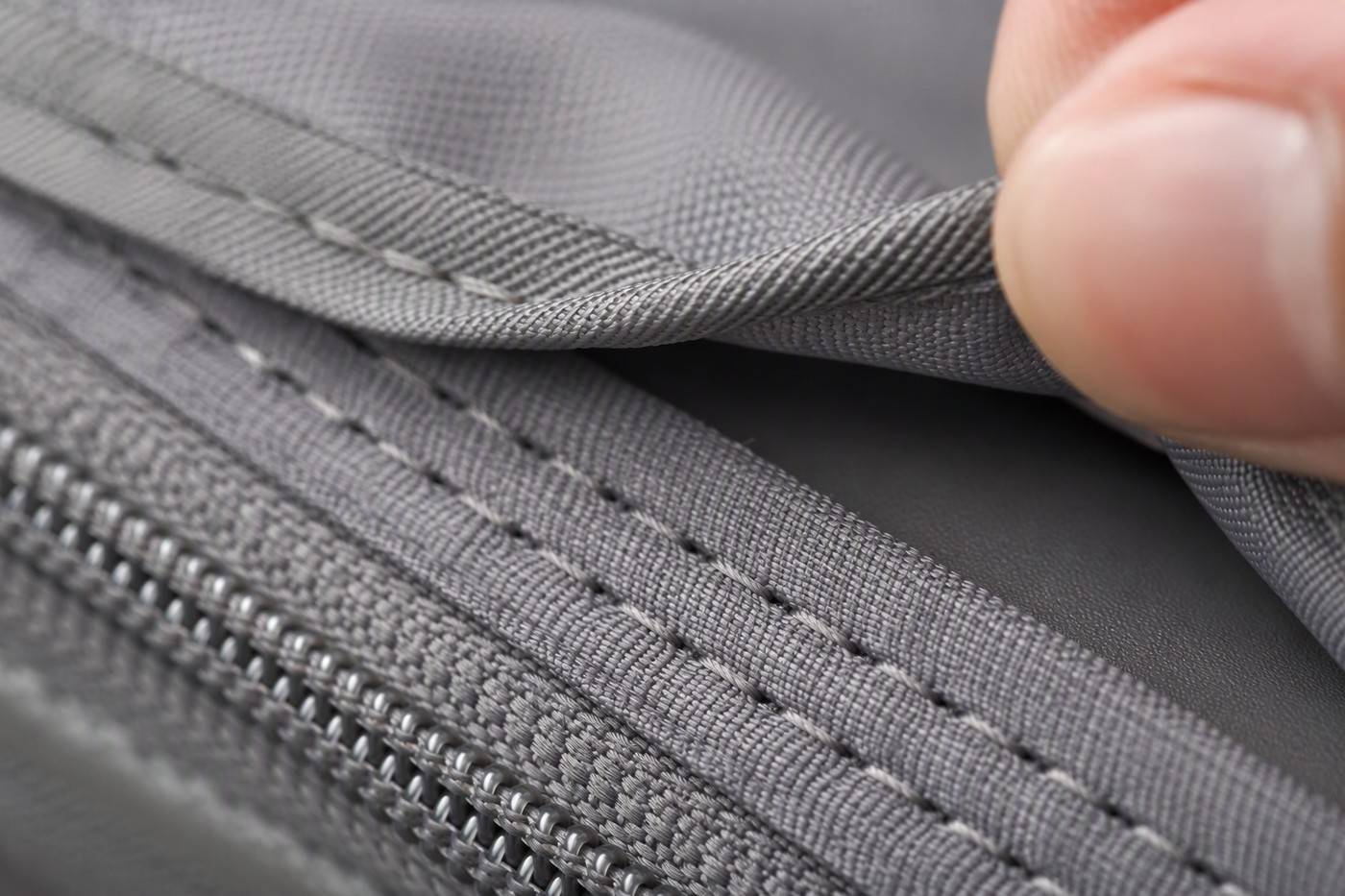
Here is why. On most suitcases the lining is a sheet of woven polyester or nylon, and it is backed by a layer of foam or a second fabric, then sewn or glued against the shell wall. That sandwich is not breathable, and it is not open to the air. Whatever moisture gets into it stays there, and the room air cannot reach it. Air-drying treats the front of the lining. The damp is behind it.
Two other places hold moisture the same way. The wheel housings collect hair, grit and dust, and a little damp turns that into a paste that works its way towards the axle. And a closed suitcase is a closed container: a zipper closure or a frame gasket is designed to keep water out, which also means it keeps damp air in. A case stored shut with any residual moisture inside is a small sealed box.
Start Outside: Shell, Then Wheels, Then Zipper Tape
Work from the outside in, so you are not pushing dirt into an interior you have already cleaned.
The shell. A soft cloth, lukewarm water and a little mild soap. Wipe, then wipe again with clean water, then dry with a towel. Do not soak it, do not use solvent, and do not use an abrasive pad. On a polycarbonate, ABS, PC+ABS or polypropylene shell you are only removing surface film; there is nothing to scrub for. If you are comparing shell materials and what each one tolerates, we cover the trade-offs in hard shell vs soft shell luggage.
The wheels. This is the highest-return maintenance on the whole case. Wheels, handles and locks are the three components that break first, and around 60% of luggage returns trace back to a single part that costs well under a dollar. The usual mechanism is not impact, it is accumulation: hair wrapped around the axle, grit in the housing, and a rolling surface that no longer rolls straight. We go through the failure modes in why 60% of luggage returns are about the same part.
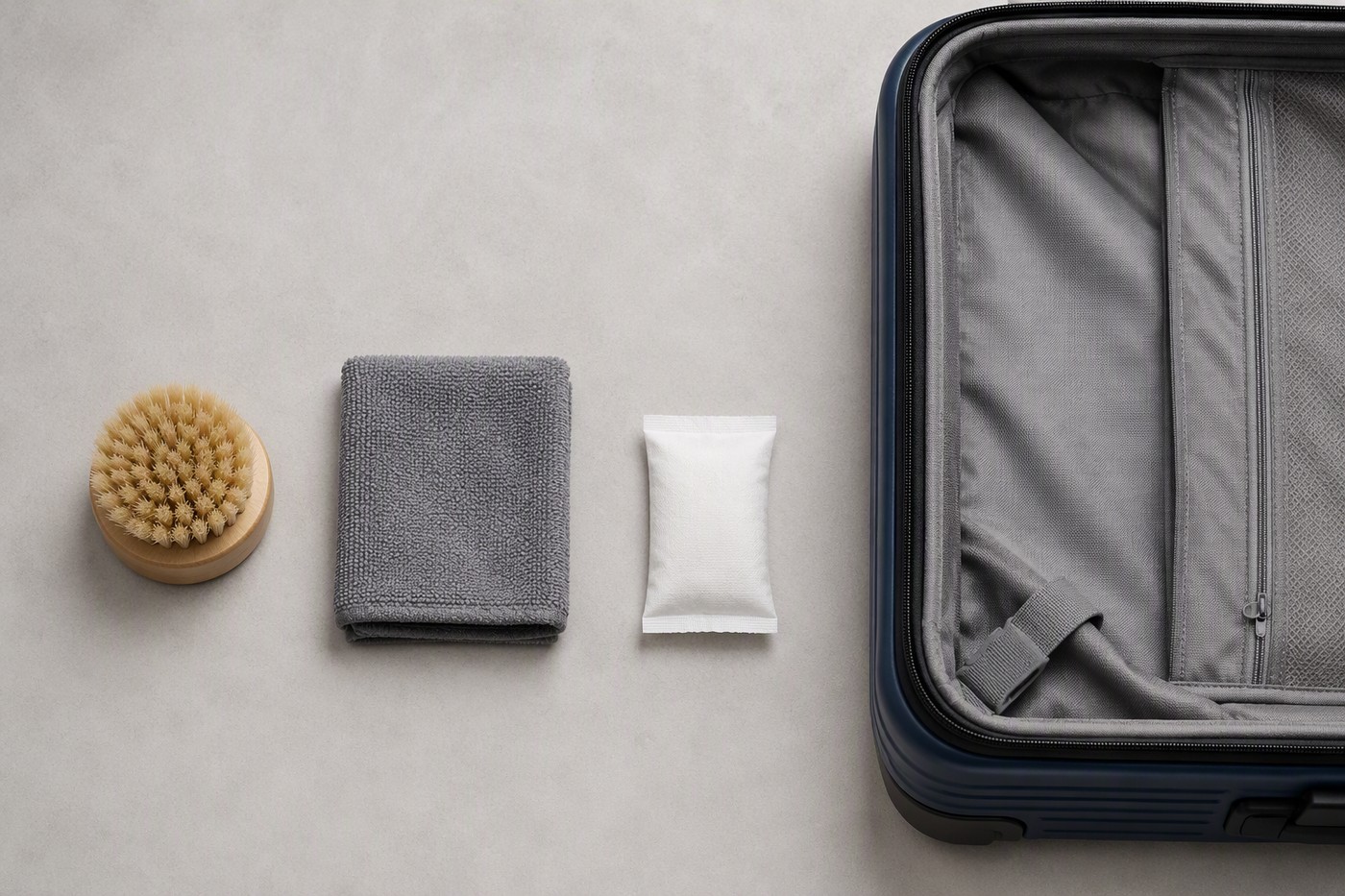
What to do: turn the case over, and with a stiff brush or a wooden pick, pull the hair and lint out of the wheel housing. A dry brush first. Only then a barely damp cloth. Do not run water into the housing and do not spray lubricant into it; both attract more grit than they remove. If the wheels are the swivel type, check all four, because one sticky wheel is what makes a loaded case pull to one side.
The zipper tape. Sand and grit in the teeth is what shortens a zipper's life, not water. Brush along the tape with a soft brush, in the direction the teeth run, with the zipper closed, then open it and brush the exposed section. Our zippers are co-developed with YKK and SBS and are cycle tested to 30,000 open and close cycles, and we also build cases with IPX4 waterproof zippers. Water resistant is a property of the closure, not an invitation to soak the tape. Wipe it, do not submerge it.
The Lining Rule: When You Can Wipe It, and When You Must Never Soak It
What you can do to a lining depends on what the lining is made of, and this part is worth knowing before you attack a stain.
Polyester is the workhorse: inexpensive, water resistant, easy to clean, resistant to fading, and it does not pill easily under normal use. Its weakness for our purposes here is that it is not very breathable, which is exactly why a damp polyester lining takes so long to dry from the inside. Nylon is the upgrade: better abrasion resistance and a better hand feel, at a higher cost. Cotton and silk appear at the top of the market and behave differently again. We compare all four, with the numbers we quote buyers, in luggage lining materials explained.
Then the manufacturing detail that changes the whole routine: on most suitcases the lining is fully sewn in. It is not a removable bag. You cannot take it out, and you cannot get air behind it. So the practical rules are short.
- Wipe with a cloth that is damp, not wet. Ring it out first.
- Never fill the case with water, and never stand it in a bathtub.
- Never machine wash a sewn-in lining.
- Never use bleach on a dyed lining. It strips the colour and weakens the fibres.
- Spot-test any cleaner on a hidden corner first, then wait for it to dry, because some cleaners only stain once they dry.
If the lining is designed to come out, treat it as a separate item and follow its own care label. That is the entire point of making it removable. Some of the linings we build are also antibacterial and water resistant, which helps against the bacteria that cause odour, but no finish replaces drying. A treated lining that stays damp will still smell.
Drying Is the Step That Decides Whether You Get Mold, Not the Cleaning
Cleaning removes the food the mold would grow on. Drying removes the water. If you only do the first, you have made a cleaner environment for the same problem.
Open the case into two flat halves and prop the lid so air can move through the whole interior, including the lid's own pockets. Keep it out of a closed bathroom and out of direct hot sun, because sustained heat is hard on shells, gaskets and adhesives over time.
Forget waiting a fixed number of days. Use a test instead. Press a dry paper towel hard into three places: the seam where the lining meets the shell wall, the bottom corners, and behind the zipper tape. If the paper comes back even slightly damp, the case is not dry, no matter how long it has been sitting. This is the same reason we test a case's interior after the environmental and chemical checks in our lab: the inside of a case holds water longer than the outside.
Aluminum frame cases have one extra step. The frame closes against a gasket, and that gasket channel is a shallow trough that collects water. Wipe the channel dry, then let it air. If you want to know whether the gasket is still doing its job, close the case and run your finger along the seam all the way around: a good frame gives you a consistent, minimal gap with no catching and no sharp edge. A gap that widens and narrows has already started to fail. We use that ten-second check on the line and in the showroom, and it is described in aluminum frame luggage: durability meets design.
Three Smells, Three Different Fixes
Not every smell is moisture, and treating a smoke smell like a damp smell wastes a week. Identify the source first.
| What you smell | Most likely source | What to do | What not to do |
|---|---|---|---|
| Damp, musty, like a basement | Moisture held behind the lining or in the frame gasket channel | Dry it completely first using the paper towel test, then air the case open | Do not mask it with fragrance or a spray; the water is still in there |
| Sour, like old sweat | Sweat and skin residue on the lining and on the interior straps | Wipe the lining with a damp cloth and a little mild soap, then dry fully | Do not soak a sewn-in lining, and do not scrub the print or coating |
| Food, spice, or smoke | Odour absorbed into the lining fibres and the backing foam | Air it open in a shaded, ventilated place for as long as it takes; a shallow dish of activated charcoal or baking soda inside the open case is a common household approach | Do not spray perfume or disinfectant into the lining; it adds a second smell to the first |
One rule applies to all three: the case must be genuinely dry before it is closed again, even for a week. If you close it damp, you have restarted the problem.
Hard Shell, Soft Shell, Aluminum Frame: What Changes
Hard shell (polycarbonate, ABS, PC+ABS, polypropylene). The easiest to clean and the least likely to absorb anything. The shell wipes down, and the work is entirely inside: lining, pockets, straps, the dividers. If the case has a zipper closure, the tape is a dirt trap. If a hard case has been stored in a damp place, the interior fittings hold the moisture, not the shell.
Soft shell (fabric outer). The outer fabric absorbs, so the order changes: brush the fabric dry first, then spot-clean, then air-dry with the case open. Water on a woven outer fabric can push dirt deeper into the weave, which is why dry brushing comes before any wet cleaning. Do not machine wash unless the case is explicitly built for it.
Aluminum frame. The shell is the durable part; the gasket and the latches are the parts that need attention. Wipe the frame down, dry the gasket channel, and check the lid alignment with the finger test above. Avoid abrasive polishes on the anodised surface.
On all three types, the wheel routine is identical, and on all three types the wheel is still the part most likely to end you up with a review you did not want. The components themselves are compared in why wheels break easily.
Long-Term Storage: Air Gap, Desiccant, and Whether to Take the Modules Out
The mistake people make in storage is the same one they make after a trip: they close the case.
- Do not nest cases inside each other while closed. The outer case seals the inner one, and both stay damp if there is any humidity in the room.
- Store the case open, or with the zipper left partly open. A little airflow beats a sealed container. If you must store it closed, put a desiccant pack inside and check it periodically.
- Take removable interior modules out. Dividers, wash bags and removable liners dry and air far better on their own than folded inside a case. This is also how they avoid taking on the smell of everything stored next to them.
- Do not stack weight on a stored case. Load on the shell or on the frame while it sits can set a deformation you cannot undo later.
- Treat a humid storage room as a humidity trap. If the room is damp, so is the case. Rotate or replace the desiccant instead of assuming it keeps working.
Wheels need nothing in storage except being clean and dry. A wheel that goes into storage with grit in the housing comes out with a flat spot or a wobble.
If You Buy Luggage to Sell: Two of These Problems Are Specification Decisions
For a brand or importer, everything above is a support-cost forecast. The complaints you will receive about smell and about damp interiors are largely determined by three choices made long before the first customer opens the box.
- Is the lining removable? A removable, washable liner turns the most common complaint into an instruction that takes five minutes. A fully sewn-in lining turns the same complaint into a return.
- What is the lining material and what is behind it? Woven polyester is affordable and water resistant but not breathable, so a damp lining dries slowly. The backing layer and how it is attached decide whether moisture can ever get out again.
- What is the gasket and how is the channel formed? On a frame case, the gasket both seals against water and traps it. The channel geometry and the gasket material decide how easily a customer can dry it.
These are specification conversations, and they are exactly the kind we have at the sampling stage, alongside the material and component choices that decide how a case survives travel. If you want to see how we structure the durability side, the eight tests we run on a shipped batch are set out in the eight tests that decide if your luggage survives, and the spare-parts side is covered in our repairability and spare parts guide. Linings can also be specified with recycled content, which comes with its own documentation: see what a GRS scope certificate actually means.
If you would rather discuss a specific brief, our OEM and ODM luggage manufacturing page is the place to start, and the details of premium zipper and lining specifications are worth reading before you write your first spec sheet.
Frequently Asked Questions
Can I wash a suitcase in the bathtub?
No. A sewn-in lining cannot be dried from behind, and filling a case with water pushes moisture into the very layer that causes the problem. Wipe the lining with a damp cloth and dry the case open.
How do I get mildew out of a suitcase lining?
Start by drying it completely, because mildew needs moisture to keep growing. Then wipe the surface with a damp cloth and a little mild soap, and air the case open in a ventilated, shaded place. Do not use bleach on a dyed lining, and do not close the case until the paper towel test comes back dry.
Why does my suitcase still smell after weeks of being empty?
Because the moisture is behind the lining or in the frame gasket channel, where room air cannot reach it. Empty is not the same as dry. Use the paper towel test in the seams, the bottom corners and behind the zipper tape.
Do I really need to clean the wheels?
Yes, and it is the single highest-return thing you can do. Hair and grit around the axle are a common cause of the wheel failures behind most luggage returns. A dry brush and a pick will remove more than any spray.
Should I store my suitcase open or closed?
Open, or with the zipper partly open. A closed case is a sealed container. If it has to be closed, add a desiccant pack and check it, and never store it closed while there is any doubt about whether it is dry.