
Choosing a luggage manufacturer is not only a price comparison. Buyers must also confirm whether a factory can turn a brief into a stable sample and repeat the approved standard in production.
A suitable supplier gives clear answers before tooling or production begins. This guide covers project preparation, customization routes, quality evidence and how our team at CLK handles development.
What Should Buyers Prepare Before Contacting a Luggage Factory?
A clear brief helps the factory quote the product you are actually planning to buy. Without it, two quotations may look comparable while using different shell thicknesses, wheel structures, linings or packaging.
Start with the commercial use of the product. Retail products, promotional luggage and travel collections have different requirements for durability, packaging and order volume.
A useful first brief should include:
| Information | What to specify | Why it matters |
|---|---|---|
| Product type | Carry-on, checked luggage, luggage set, front-opening case or aluminum-frame case | Determines structure, tooling and component options |
| Target market | Country, sales channel and expected retail position | Affects sizing, labeling, testing and packaging |
| Material | ABS, PC, ABS plus PC, polypropylene or another requested construction | Influences appearance, weight, impact behavior and cost |
| Size and capacity | External dimensions, internal volume and expansion requirement | Prevents misunderstandings about usable space and airline positioning |
| Components | Wheels, trolley system, handles, lock, zipper and lining | Defines performance and replacement expectations |
| Branding | Logo method, badge, lining print, labels and packaging | Affects sample work, tooling and minimum quantities |
| Quantity | Units by size, color and design | Needed for accurate MOQ and unit pricing |
| Deadline | Required delivery date and destination | Allows the factory to assess sampling, production and shipping time |
Cabin size should not be described as universally approved. IATA gives 56 × 45 × 25 cm, including wheels and handles, as a general reference while noting that allowances vary by airline, cabin and aircraft.
Buyers should verify the rules of the airlines relevant to their market before approving product dimensions.
Before requesting a quotation, buyers can use the same information when reviewing our OEM and ODM luggage capabilities.
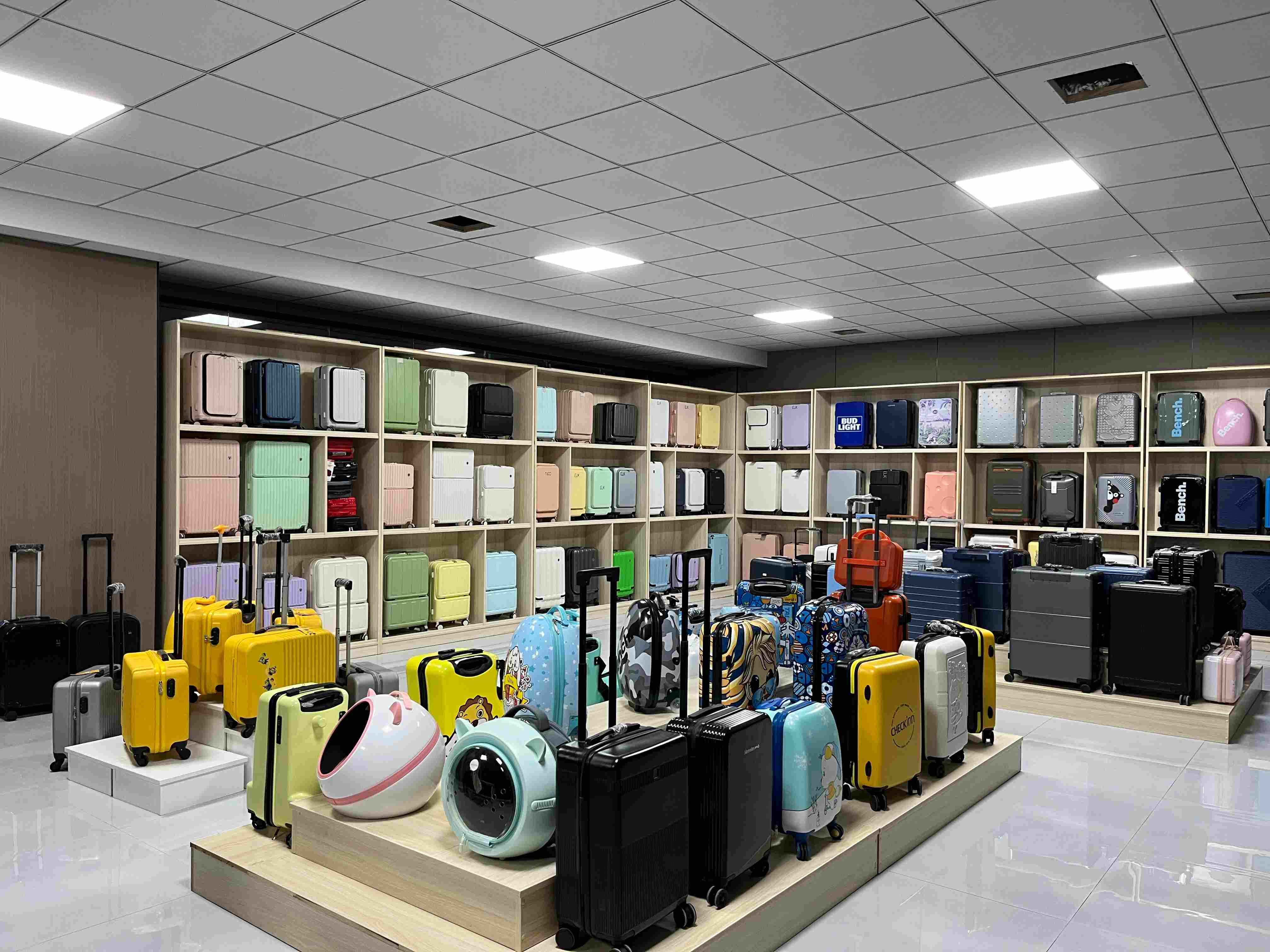
Which Customization Route Fits the Project?
"Custom luggage" can mean anything from adding a logo to developing a new shell. Defining the route early makes the quotation easier to understand and reduces unnecessary development work.
| Route | Typical scope | Suitable for | Main point to confirm |
|---|---|---|---|
| Private label | Existing product with logo, labels or packaging changes | Market testing, gifts and faster launches | Available design, branding method and color quantity |
| ODM customization | Existing platform with selected colors, lining, components and feature changes | Brands that need differentiation without a completely new structure | Which parts can change without new tooling |
| OEM development | Buyer-led specification or design with structural adaptation | Established brands and channel-specific products | Drawings, performance criteria, ownership and validation steps |
| New mold project | Original shell pattern or structural tooling | Products that need a distinct visual identity | Tooling scope, revision rules, mold ownership and maintenance |
A new mold is not always necessary. If the main goal is to test demand, an existing platform with controlled changes may provide a faster and lower-risk route.
New tooling becomes more relevant when shell appearance, a protected pattern or a special structure is central to the product concept.
In that case, the agreement should define:
- Who owns the mold
- Where the mold will be stored
- Whether it can be used for another customer
- Who is responsible for maintenance
- How future modifications will be charged
CLK published manufacturing profile lists more than 200 self-developed molds and more than 80 exclusive molds under customer arrangements.
These figures help buyers understand the available development base. The ownership and availability of a particular mold should still be confirmed in writing for each project. More information is available on the Why Choose CLK page.
What Determines MOQ, Sample Time and Production Time?
MOQ is affected by more than factory capacity. Material purchasing, color batching, printed lining, custom metal parts, packaging and production setup can each create a separate minimum.
For project planning, we list 300 pieces per color as a reference for standard OEM orders and 500 pieces for ODM projects. Some products based on existing tooling may support lower quantities.
These are starting points for discussion, not universal terms. The final MOQ should be confirmed by model, size, color and customization list.
Sample and production times also depend on the work involved:
| Project stage | CLK planning reference | Variables to confirm |
|---|---|---|
| Standard custom sample | 7 to 15 days | Material availability, logo process and component selection |
| Complex sample | 15 to 30 days | Structural changes, custom parts, mold work and revision rounds |
| Typical production | 30 to 45 days | Order size, approved sample, material readiness and factory schedule |
These periods come from our published OEM and ODM process. They should be reconfirmed when the purchase order is placed.
Buyers should also ask when the production period begins. It will normally start only after the sample, color, packaging artwork, payment terms and order details have been approved.
A realistic schedule should include time for sample evaluation and at least one possible revision. Allowing for this is safer than assuming that the first physical sample will enter production immediately.
How Should Buyers Evaluate Luggage Quality?
A polished sample does not prove that mass production will remain consistent. Buyers should ask how the factory controls incoming materials, assembly, final inspection and shipment release.
The inspection plan should connect each test to a measurable requirement. CLK published process includes:
- Wheel-running tests
- Trolley and handle shaking tests
- Wheel-drop tests
- Zipper-fatigue tests
- Color-fastness tests
- Salt-spray tests
- High and low temperature shell tests
A list of test names is not sufficient on its own. Buyers should request the testing method, sample quantity, acceptance limit and result for the tests relevant to their product.
Use this evidence checklist before approving production:
- A signed sample or clearly identified golden sample
- A bill of materials with approved components and colors
- Dimension and weight tolerances
- Test reports linked to the ordered model
- In-process and final inspection records
- Defect classifications and acceptance criteria
- Packaging and carton-drop requirements
- A corrective-action procedure for nonconforming goods
Compliance requirements should be determined by the destination market.
How CLK Support a Custom Luggage Project
At CLK, we have manufactured luggage since 2009 and support private-label, OEM and ODM projects.
CLK published product range includes:
- Carry-on luggage
- Checked luggage and luggage sets
- Front-opening luggage
- Aluminum-frame cases
- Wide-trolley luggage
- Hybrid luggage
- Smart-travel products
Customization can cover shell material and color, lining, internal compartments, wheels, handles, locks, metal badges, printing, woven labels, hangtags and retail packaging.
Reviewing these elements together helps buyers avoid component conflicts. For example, a selected wheel structure may affect internal capacity, while a metal logo badge may require changes to the shell or lining.
Our seven-stage ODM workflow covers requirements, concept development, design confirmation, prototyping, testing, production and delivery.
Buyers should still assign an approval owner at every stage and keep decisions in a written specification. CLK service overview and manufacturing process provide a starting point.
A Published Custom-Mold Example
For a brand-specific raised panel pattern, our team first reviewed the relief proportions, texture compatibility and scope of mold modification.
Three-dimensional views were prepared before tooling. This gave the buyer an opportunity to evaluate the panel appearance without waiting for a physical mold.
The buyer then requested a shallow line around the logo. We revised the design, produced the tooling and sample, and supplied physical photos and videos for review before mass production.
This case illustrates three practical points:
- Visual details should be approved before tooling
- Design revisions should be included in the schedule
- Physical samples should be compared with the approved digital design
The complete project is available in our custom panel molding case.
Questions Buyers Ask Before Requesting a Quote
1. Can a factory copy a reference suitcase exactly?
A reference product can communicate style and function, but protected designs, trademarks and patents must be respected. Use the reference to define requirements, then develop an authorized product specification.
2. Should the lowest quotation decide the order?
No. Compare material grade, shell thickness, components, testing scope, packaging, tooling, defect terms and delivery basis.
A lower price may cover a different product specification.
3. How many samples are usually needed?
Simple logo or color changes may require one approval sample. Structural modifications often need additional rounds.
The number of samples, sample cost and approval method should be agreed before development begins.
4. What should be approved before mass production?
Approve the physical sample, dimensions, color, components, artwork, packaging, testing criteria, tolerances and delivery plan.
Any accepted differences from the original brief should also be recorded.
5. What information do you need for a quotation?
Provide the product type, sizes, material, target market, quantity by color, customization list, packaging, testing requirements, destination and required delivery date.
Buyers with an early-stage concept can also share drawings, reference images and a target price range.
FAQ
Q1. What is the MOQ for custom luggage from China?
A: MOQ depends on the luggage model, color, material and level of customization. At CLK, 300 pieces per color is a planning reference for standard OEM orders, while ODM projects generally start from 500 pieces. Products using existing molds may support smaller trial quantities. The final MOQ must be confirmed for each size, color and design.
Q2. What is the difference between OEM, ODM and private-label luggage?
A: Private-label luggage normally uses an existing product with customized logos, labels or packaging. ODM allows buyers to modify an existing platform through colors, materials, components and selected features. OEM development follows a buyer's own specification or design and may involve structural changes or new tooling. The appropriate route depends on the required differentiation, budget and launch schedule.
Q3. How long does it take to produce custom luggage?
A: At CLK, a standard customized sample generally takes 7 to 15 days. A complex sample involving structural changes, custom components or mold development may take 15 to 30 days. Typical mass production takes approximately 30 to 45 days after sample and order approval. Material availability, order quantity and production schedules can affect the final timeline. See our OEM and ODM manufacturing process.
Q4. Can I order a luggage sample before mass production?
A: Yes. Buyers should approve a physical sample before mass production begins. The sample should be checked for dimensions, weight, color, logo position, wheel movement, trolley operation, zipper or lock function, lining and overall workmanship. Any approved differences from the original specification should be recorded in writing and reflected in the production documents.
Q5. What parts of a suitcase can be customized?
A: Depending on the selected model, customization may include shell material, Pantone color, surface pattern, lining, internal compartments, wheels, trolley handles, carry handles, locks, zippers and logo applications. Hangtags, woven labels, dust bags, retail boxes and export cartons can also be developed for the project. Some changes require new tooling or higher minimum quantities, so each item should be confirmed before quotation.
Q6. Do I need a new mold for custom luggage?
A: Not necessarily. An existing mold may be suitable if the project mainly requires a custom color, logo, lining, component selection or packaging. A new mold is more relevant when the product needs an original shell pattern, different dimensions or a new structural feature. Before paying for tooling, confirm the mold cost, ownership, storage, maintenance and permitted use in writing.
Conclusion
Choosing a custom luggage manufacturer in China requires more than comparing unit prices. Buyers should define the product brief, choose the right private-label, OEM or ODM route, confirm MOQ and lead times, and approve samples before production. Quality tests, written specifications and mold ownership help reduce sourcing risks. With established customization, tooling and quality-control processes, CLK supports wholesale luggage projects from initial design through mass production and shipment.