
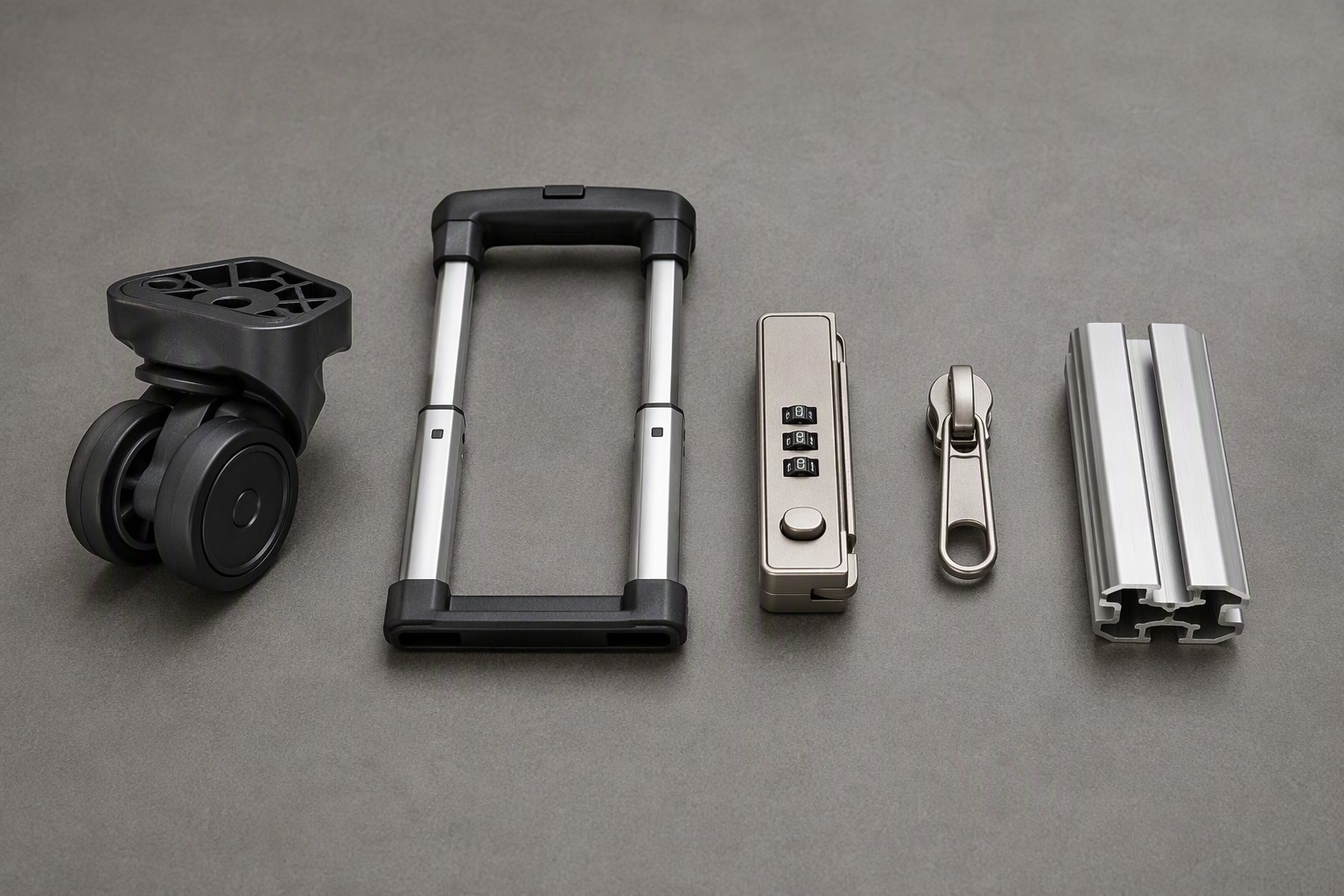
A suitcase is not covered by one standard. It is covered by a product standard for the finished case and a separate series of parts standards for everything that moves. In China that parts series is QB/T 1586《箱包五金配件》 — luggage hardware fittings — and it is divided into five books: locks, wheels, carrying handles, aluminium alloy profiles and telescopic handles. If your purchase order names only the product standard and says nothing about the parts, you have left the wheel, the trolley, the lock and the handle to the supplier's discretion.
This article covers what each book in the QB/T 1586 series actually is, which edition is current, what the 2010 revision changed compared with 1992, the separate method standards that run the actual tests, and — just as importantly — the things these standards do not give you, which stay in your purchase order. For the finished-product side, see our companion piece on which standard you actually inspect luggage against.
The Direct Answer
Luggage hardware in China is governed by QB/T 1586, a five-part series, all current editions dated 28 December 2010, effective 31 March 2011, approved by the Ministry of Industry and Information Technology: 1586.1 case locks, 1586.2 case wheels, 1586.3 carrying handles, 1586.4 aluminium alloy profiles, and 1586.5 telescopic handles. The physical tests are then run under separate method standards — QB/T 2917-2007 for wheel abrasion, QB/T 2919-2018 for telescopic-handle fatigue — which is why a competent test report cites two numbers per part, not one.
One detail in that list is worth pausing on, because it says something about how the industry thinks: the telescopic handle only received its own standard in the 2010 revision. The 1992 edition had four parts. Part .5 did not exist. For two decades the trolley — the single most load-bearing moving assembly on a modern suitcase — had no standalone parts standard to be bought against.
The series, verified item by item
Every row below was read off the official Chinese standards platforms, not from a summary article. Status and dates are the platform's own records.
| Standard | Covers | Published | Effective | Approved by |
|---|---|---|---|---|
| QB/T 1586.1-2010 | 箱包五金配件 箱锁 — case locks | 28 Dec 2010 | 31 Mar 2011 | MIIT |
| QB/T 1586.2-2010 | 箱包五金配件 箱走轮 — case wheels | 28 Dec 2010 | 31 Mar 2011 | MIIT |
| QB/T 1586.3-2010 | 箱包五金配件 箱提把 — carrying handles | 28 Dec 2010 | 31 Mar 2011 | MIIT |
| QB/T 1586.4-2010 | 箱包五金配件 箱用铝合金型材 — aluminium alloy profiles for cases | 28 Dec 2010 | 31 Mar 2011 | MIIT |
| QB/T 1586.5-2010 | 箱包五金配件 拉杆 — telescopic handles | 28 Dec 2010 | 31 Mar 2011 | MIIT |
| QB/T 5085-2017 | 箱包五金配件 磁力扣 — magnetic clasps | 2017 | — | MIIT |
| QB/T 2917-2007 | 箱包五金配件 走轮耐磨试验方法 — wheel abrasion test method | 2 Dec 2007 | 31 May 2008 | NDRC |
Two adjacent standards are easy to miss and worth knowing, because they govern the finish rather than the part: QB/T 2002.1-1994 for electroplated coatings and QB/T 2002.2-1994 for sprayed coatings. Hardware that fails in service is often not a design failure but a coating failure — pitting on a plated buckle, flaking on a sprayed frame — and these are the documents that define those properties.
What the 2010 revision changed
The 1992 edition of the same series was issued on 30 August 1992 and took effect on 31 March 1993 under the then Ministry of Light Industry. Comparing the two tells you what the industry learned in eighteen years.
| Item | 1992 edition | 2010 edition |
|---|---|---|
| Parts covered | Four: locks, wheels, handles, aluminium profiles | Five: the four above plus telescopic handles (.5) |
| Issued / effective | 30 Aug 1992 / 31 Mar 1993 | 28 Dec 2010 / 31 Mar 2011 |
| Approving body | Ministry of Light Industry | Ministry of Industry and Information Technology |
| On the wheels book (.2), per its own preface | — | Added terminology and definitions, product classification and appearance requirements; revised the abrasion-resistance and impact test methods; added a sprayed-coating adhesion requirement |
The last row is the commercially interesting one. Adding an adhesion requirement to a part standard is the industry acknowledging that a wheel can be geometrically correct and load-correct while still failing because its coating lifts. That is a failure mode buyers see in the field long before they see a broken wheel, and it is now anchored to a clause rather than to a supplier's promise.
The method standards that actually run the tests
Product and parts standards state requirements. Method standards state how you prove them. When a lab quotes a test, the number that determines what physically happened to the suitcase is the method number, not the product number.
| Part or property | Method standard |
|---|---|
| Wheel abrasion resistance | QB/T 2917-2007 箱包五金配件 走轮耐磨试验方法 |
| Telescopic handle fatigue | QB/T 2919-2018 箱包 拉杆耐疲劳试验方法 |
| Travelling / rolling performance | QB/T 2920-2018 箱包 行走试验方法 |
| Shaking impact | QB/T 2922-2018 箱包 振荡冲击试验方法 |
| Drum / tumbler impact | QB/T 4116-2023 箱包 滚筒试验方法 |
| Plastic buckle durability | QB/T 5247-2018 箱包配件 塑料插扣耐用性能试验方法 |
Note the years against the parts series. The parts books are all 2010; the method standards that test the same components have since moved to 2018 and 2023 editions. A specification that names a 2010 parts standard and stops there is naming the requirement but not the current procedure.
Wheels: the part that generates the returns
QB/T 1586.2-2010 defines the wheel as a part; QB/T 2917-2007 defines how its abrasion resistance is measured. Between them they give you the right to ask for a wheel test and a defined way to run it. What they do not give you is a catalogue of standard sizes — and that gap is where replacement-part problems start. For why wheels dominate warranty claims, see why wheels break easily.
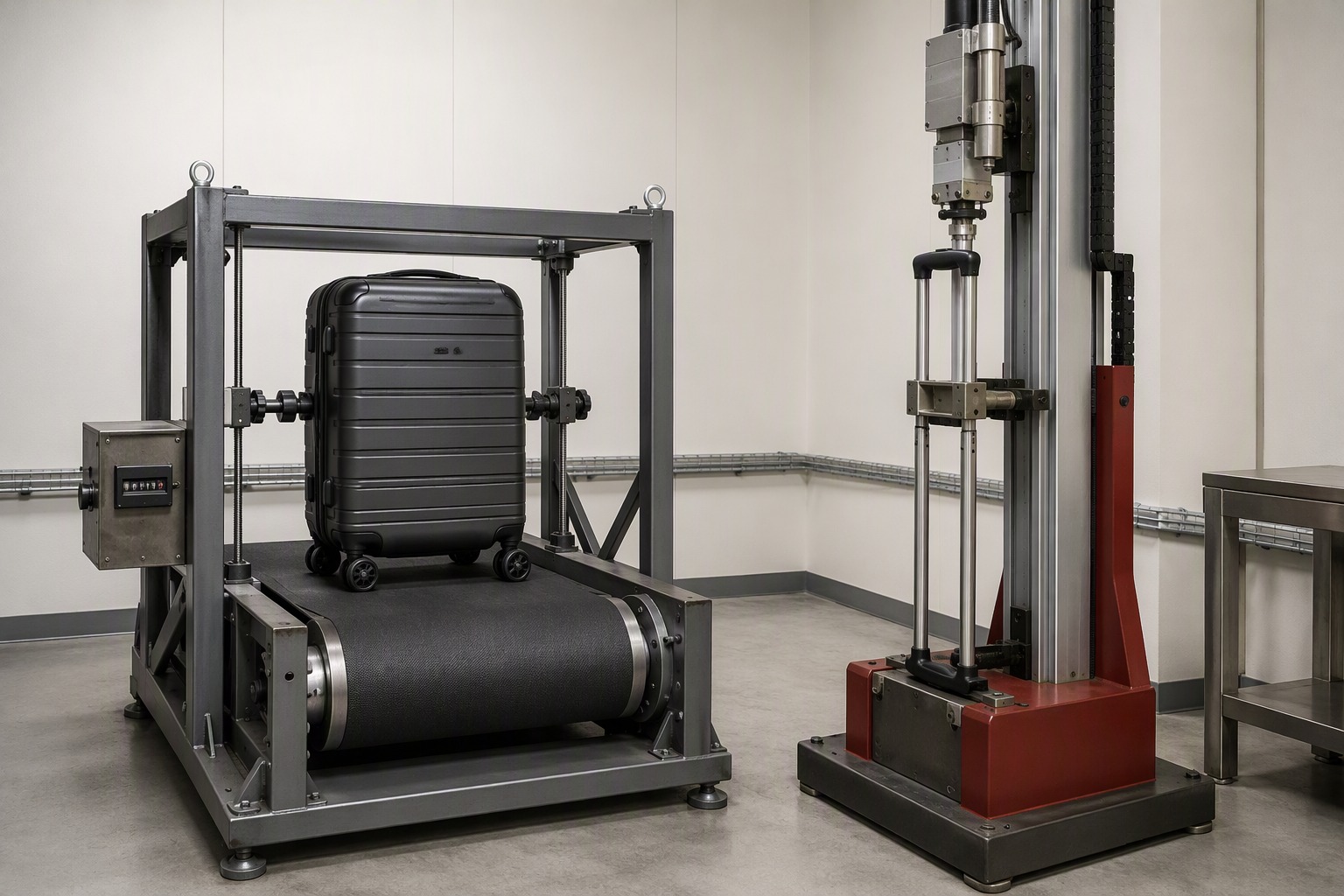
What is publicly documented about wheel dimensions comes from the replacement-part market, not from manufacturers' specification sheets. Across retail replacement listings the recurring envelope is roughly 47 to 84 mm in diameter, 9 to 27 mm in rim width, a bearing bore of 6, 6.1 or 8 mm, and a mounting hole spacing of about 27 to 50 mm. Those figures are the retail replacement market's convention, not a standard's — treat them as the shape of the market, not as a specification.
Two dimensions decide whether a wheel is replaceable at all: the overall height and the hole spacing of the mounting plate. Retail listings consistently lead with exactly these two numbers, which tells you what breaks in practice — the wheel is fine, the mounting plate does not match.
On materials, the trade vocabulary separates polyurethane (PU), PVC, TPE/TPR and nylon treads, with PU most often labelled quiet and abrasion-resistant, often in combination with a glass-filled polymer fork. What is not publicly documented is the comparison a buyer actually wants: no manufacturer test data was obtainable in this research comparing single versus double wheels on noise in decibels, service life in cycles, or load rating; and no per-wheel load rating for a luggage wheel was published by any manufacturer. The one load figure that circulates openly is from the industrial caster world — a 3-inch polyurethane wheel rated 275 lb — and it is not transferable to a suitcase. If a supplier quotes a load rating for a luggage wheel, ask what test produced it. For the material question specifically, see TPU wheels versus PVC wheels.
Trolleys: the newest standard in the series
QB/T 1586.5-2010 covers the telescopic handle; QB/T 2919-2018 covers its fatigue test; and the finished-product standard lists handle fatigue resistance as an inspection item. That is a complete chain of custody for the trolley — requirement, method, and product-level verification.
What the public record does not contain is the engineering detail: tube diameter, number of stages, and internal locking mechanism are not published in any accessible manufacturer specification. Brand marketing does disclose some performance claims — one brand publishes that its aluminium handle tubes hold sway within 10 mm — but that is a brand's own claim, useful as a benchmark question to put to a supplier, not as a standard limit.
There is one number in circulation that deserves explicit rejection. Figures such as "the industry requires 3,000 fatigue cycles and leading brands achieve over 6,000" appear in Chinese consumer media, not in any standard text that could be verified. It is not adopted here. Ask your supplier which method standard was used, at what load, and to how many cycles — the answers to those three questions are checkable; the marketing number is not.
Locks: the part standard, and the TSA system on top of it
QB/T 1586.1-2010 covers the case lock, and testing-house item lists describe its scope as flexibility, durability, security of closure, and coating adhesion. The finished-product standard separately includes case and bag lock durability. So the lock is governed twice: once as a component, once as part of the assembled case.
Above the Chinese standard sits the TSA system, which is frequently misunderstood. The mechanics are worth stating precisely, because they come from the official sources:
- TSA has master keys obtained under agreements with the two lock-authorisation programmes — Travel Sentry and Safe Skies — so that qualifying branded locks can be opened for inspection instead of being cut.
- Each qualifying lock carries a special code so that screening staff can identify which opening tool applies. Travel Sentry's identifier for its programme is the Red Diamond mark.
- TSA explicitly does not vouch for the security effectiveness of these products, and may still remove them where it deems necessary.
- A TSA lock is not legally required. It is strongly recommended in countries where inspection happens, and its value is "inspection without destroying the lock" plus deterrence against opportunistic interference — not a guarantee against theft.
- Both authorised programmes report different coverage figures, and they do not agree with each other. Travel Sentry states 80-plus countries and 800 airports; a lock manufacturer's page describing the same programme states 44 countries and 650-plus airports. The two figures should not be mixed or quoted as one.
The practical consequence for a purchase order: "TSA lock" is not a specification. What is specifyable is the authorisation programme, the presence of the special code, the form — combination versus keyed, and whether it is integrated into the case or supplied as a padlock — and the component standard, QB/T 1586.1-2010, with its mechanical requirements. For the wider document set, see the luggage certification checklist.
Handles, profiles, plating, zips and buckles
The remaining parts are less glamorous and just as capable of generating a claim.
| Part | Governing document | What it gives you commercially |
|---|---|---|
| Carrying handles | QB/T 1586.3-2010 箱包五金配件 箱提把 | A standard to cite for the top and side carry handles, separate from the telescopic handle — the two are frequently confused in specifications |
| Aluminium case frames | QB/T 1586.4-2010 箱包五金配件 箱用铝合金型材 | The profile is governed as a part; the finished product adds an aluminium frame surface hardness test, so frame hardness can be verified twice |
| Plated hardware | QB/T 2002.1-1994 电镀层技术条件 | A document to cite when the failure mode is corrosion rather than breakage; the product standard separately lists hardware corrosion resistance |
| Sprayed finishes | QB/T 2002.2-1994 喷涂技术条件, plus the adhesion requirement added in QB/T 1586.2-2010 | Adhesion became a wheels-book requirement in 2010 — useful when a supplier's samples look right and field units flake |
| Zips | No part in the QB/T 1586 series. Component specifications come from the fastener maker; ASTM D2061 covers chain transverse strength, top-stop strength and slider attachment strength | Because there is no local parts book for zips, the zip is the one component where you are relying on the maker's own specification |
| Plastic buckles | QB/T 5247-2018 箱包配件 塑料插扣耐用性能试验方法 | A dedicated durability test method for the snap buckle — a part that fails silently and then fails loudly |
| Magnetic clasps | QB/T 5085-2017 箱包五金配件 磁力扣 | A 2017 addition showing the series is still being extended as hardware changes |
On zips, one numerical rule of thumb needs correcting. The widely repeated statement that a "#5 zip" means a 5 mm tooth size is a distributor's explanation, not the fastener maker's definition. The maker's own published size designations include 2CF, 3CF, 45CF, 5CNF, 8CF and 10CF — and the existence of 45CF is itself proof that the numbering is not a plain millimetre scale. Specify the maker's exact designation, not "a #5 zip".
What these standards do not give you
This is the section a supplier's sales deck will never contain, and it is the reason a parts standard alone cannot be your acceptance criterion. Five things are genuinely absent from the public record:
- No published size series for luggage wheels. There is no accessible manufacturer catalogue of standard wheel designations to buy against. The dimensional envelope that circulates publicly is the replacement market's, not a standard's.
- No single-wheel load rating. No manufacturer load figure was obtainable for a luggage wheel. Industrial caster ratings exist and do not transfer.
- No quantified single-versus-double wheel comparison. Noise, life and load differences between the two configurations are industry convention, not measured public data.
- No published trolley geometry. Tube diameter, stage count and locking mechanism are not in the public domain.
- No public sample size or acceptance rule. The parts standards define properties; the sampling plan, the number of units, and the pass/fail threshold for a shipment are commercial terms. If your specification is silent, you have not agreed a rejection rule.
None of this makes the standards weak. It defines the boundary: the standard tells you what property to require, and your purchase order must say how many, how often, and what happens when one fails.
Writing the parts into a purchase order
Six lines turn the series above into something a supplier can be held to. For the full document, see how to write a specification sheet.
| Line | What to write |
|---|---|
| Component standard per part | QB/T 1586.5 for the trolley, 1586.2 for wheels, 1586.1 for the lock, 1586.3 for carry handles, 1586.4 for the aluminium profile |
| Method standard per test | QB/T 2917-2007 for wheel abrasion, QB/T 2919-2018 for handle fatigue, QB/T 2920-2018 for rolling, QB/T 2919 family for the trolley |
| Finish requirements | QB/T 2002.1-1994 for plating, QB/T 2002.2-1994 for sprayed coating, plus the adhesion requirement in QB/T 1586.2-2010 |
| Lock specification | Authorisation programme named, special code present, form stated (combination or keyed, integrated or padlock), QB/T 1586.1-2010 for the component |
| Zip specification | The fastener maker's exact size designation (for example 5CNF or 8CF), not a "#5 zip" |
| Sampling and acceptance | Sample size, test frequency, and the rejection rule — agreed in writing, because no standard supplies it |
Two operational notes that belong with those lines. First, your incoming inspection should verify the parts against the evidence the factory already has, not re-test everything: see the factory tests a suitcase should pass before shipping and, for the paperwork side, how to verify a supplier's certificates and test reports. Second, if the case carries electronics — an electronic lock, a tracker, a USB port — the binding constraint is not the parts standard at all, it is lithium battery transport law: spare batteries and power banks travel in the cabin only, not in checked baggage; cells up to 100 Wh are permitted, 101 to 160 Wh need airline approval with a maximum of two per passenger, and anything above 160 Wh is prohibited. If a gate agent moves your carry-on to the hold, the battery must come out with you.
Frequently Asked Questions
Is QB/T 1586 mandatory for luggage sold in China?
No. The QB/T 1586 series is a recommended light-industry standard, like the product standard it sits beneath. It binds a supplier when your purchase order or contract names it. Its practical force is commercial: it is the document a testing house will cite, and the document you can put in a contract, which is more than can be said for a verbal assurance about wheel quality.
Why are the parts standards all from 2010 while the test methods are newer?
Because requirements and procedures are revised on separate cycles. The parts books — wheels, locks, handles, profiles, trolleys — were all reissued together in the 2010 revision. The method standards for the same components have since been updated, with 2018 editions for rolling, handle fatigue and shaking impact and a 2023 edition for the drum test. Name both in a specification, and check the year on each.
Does "TSA lock" mean the lock is certified?
No. There is no certification in the sense buyers usually mean. TSA obtains master keys under agreements with two lock-authorisation programmes, and qualifying locks carry a code that tells screening staff which tool to use; Travel Sentry's mark is the Red Diamond. TSA states plainly that it does not vouch for the security effectiveness of these products. What you can specify is the programme, the code, the form of the lock, and the component standard.
Why can't I find a size chart for luggage wheels?
Because no manufacturer catalogue of standard wheel designations is publicly accessible. What circulates openly comes from the replacement-parts market and from industrial casters, and neither is a specification for a new-build suitcase. In practice, wheel dimensions are agreed directly with the component supplier, and the two numbers that determine replaceability are overall height and mounting hole spacing.
About the Author
Written by the compliance and engineering team at Jiangxi Chengleke Leather Co., Ltd (CLK Luggage), a luggage manufacturer in Xin'gan County, Jiangxi Province. We buy and verify the parts described above — wheels, trolleys, locks, handles and aluminium profiles — against the QB/T 1586 series and the matching method standards, and we prepare the component documentation for each order. If you would like the parts list written into a technical confirmation sheet, send us your specification and we will return it annotated.
Related Products & Sourcing
- What standard do you actually inspect luggage against? QB/T 2155-2018 and the global standards map
- Why wheels break easily: identifying low-quality luggage components
- TPU versus PVC wheels: how component quality affects brand reputation
- How to write a luggage specification sheet that actually gets built correctly
- Seven factory tests your suitcase should pass before shipping
Sources. Series identity, part titles, publication and effective dates, approving bodies and the 1992 comparison: official Chinese standards platforms hbba.sacinfo.org.cn and std.samr.gov.cn, verified item by item on 8 October 2026; the revision content of the wheels book is from the standard's own preface as republished. Method standards: the same official platforms, including the industry-standard filing notice for QB/T 5247-2018. Lock test scope: testing-house item listings describing QB/T 1586.1-2010. TSA mechanism, the special code, the Red Diamond mark, the non-endorsement statement, the non-mandatory status and the coverage figures: tsa.gov security-screening guidance and travelsentry.org TSA lock documentation; lock manufacturer page for the alternative coverage figure. Wheel dimension envelope: retail replacement-part listings; industrial caster load figure from industrial retail. Fastener size designations: the fastener manufacturer's own product page. Lithium battery rules: FAA PackSafe lithium battery guidance. Sample size and acceptance: stated as not publicly republished by the standards or testing houses.