Personalized luggage pays off when you treat it as an identification system rather than a decoration. If the real goal is spotting your own case fast on a carousel full of dark, similar-looking suitcases, do three things: choose a large, high-contrast pattern instead of another solid color; prioritize reversible add-ons — a luggage tag, a shell cover, a sticker, a strap — before committing to anything permanent; and if you travel as a family, assign one color per person so each traveler scans for a color instead of reading tags. One production number is worth keeping in mind: large-area colors and patterns are made to order from MOQ 200 pieces, with light customization running 30–45 days, so the factory-printed layer is a production decision, while the reversible layer can change this afternoon.
Why a black case is a bad default
Black and dark gray are popular for good reasons: they hide scuffs, they look formal, and they match everything. The problem is not the color itself — it is that an enormous number of other travelers made the same choice, and a solid dark shell gives your eye almost nothing distinctive to lock onto. Small markers make it worse. A tag, a thin sticker, or a strap sits low, gets hidden behind neighboring bags, or faces away from where you are standing, so confirming "that one is mine" takes longer than it should.
In our own product line, one group of eight models differs only in the texture of the finish — the silhouette and hardware are identical. Surface variation is therefore a product-level feature, while identification is a use-level problem you solve with contrast and placement.
Four levels of personalization
Think of personalization as four layers. You can stop at any of them or stack them.
Level 1: A single color
The most common starting point. A single color is inexpensive to produce and easy to match as a set, but on a carousel it competes with every other solid case in the same color family. Treat it as a baseline — and as the mechanism for family coding later in this article — rather than a strong identifier on its own.
Level 2: Patterns and finishes
Recognition jumps here, because the eye locks onto contrast faster than onto hue. Our product line already carries a range of finishes used for made-to-order runs: marble-grain film, tropical botanical print, matte black wide horizontal grooves, deep blue with lemon-yellow color blocking, teal diagonal water ripples, light blue fine vertical stripes, matte black fine horizontal lines, and brown-tan diagonal twill. Notice what separates them. The wide, high-contrast designs read from across a room; the fine stripe and fine groove designs behave almost like a solid color at a distance. If identification is the priority, favor the bold end of that list.
Level 3: Name and initials
Letters match your identity exactly, which makes them the most certain identifier — and the most personal detail on the outside of the bag. They should be large, high-contrast, and placed where you can read them while the case stands upright. Keep the text minimal, for the privacy reasons below.
Level 4: Reversible add-ons
Tags, covers, stickers, and straps are the layer most travelers should start with. They change how the bag looks from the outside without altering the shell, they can be swapped when a design stops being distinctive, and they cost far less to experiment with than a made-to-order print run.
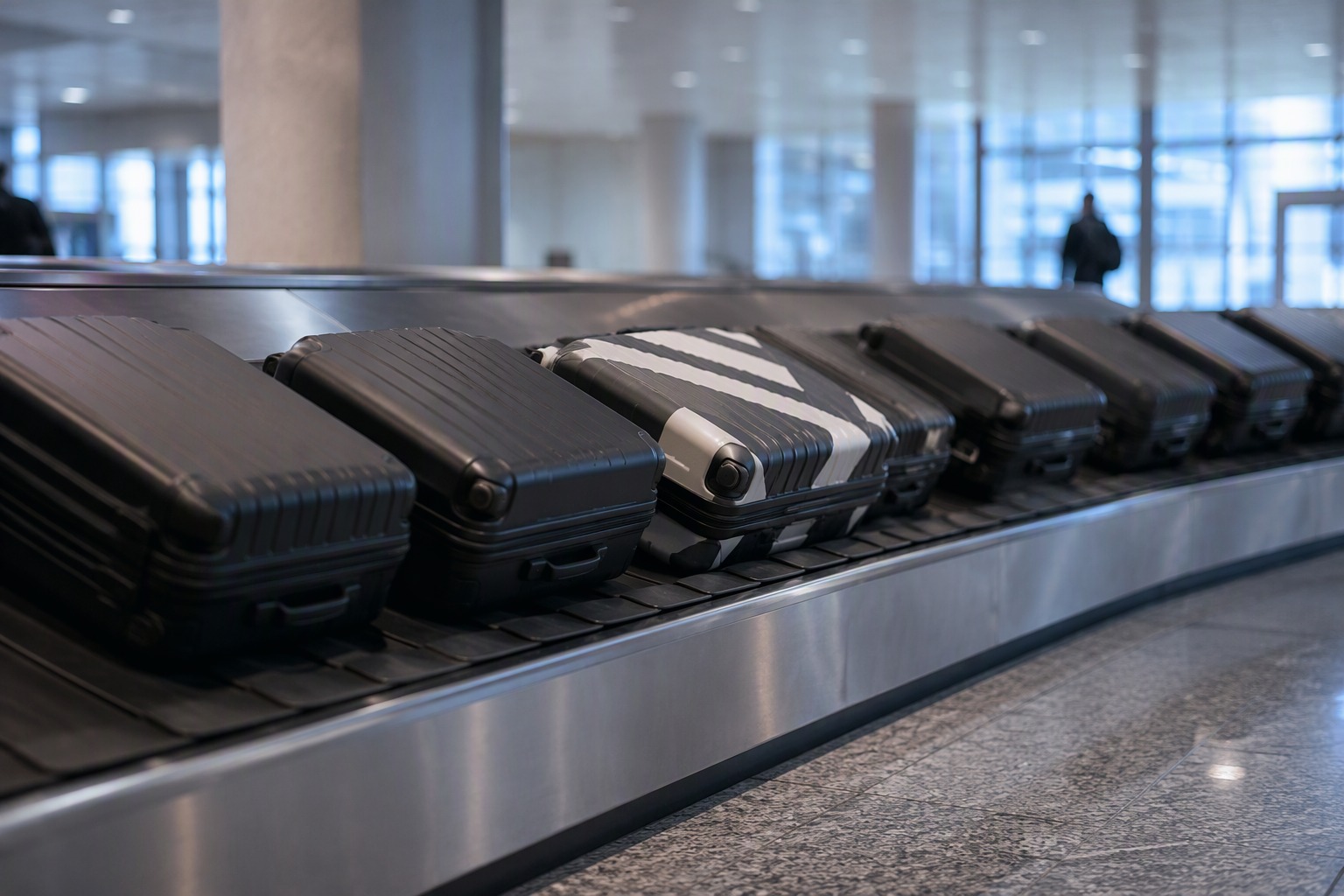
: Contrast, not brightness, is what lets you confirm your own case at a glance.
Reversible vs permanent: what each costs you
The distinction that matters most is not color versus pattern, it is reversible versus permanent.
Large-area colors and patterns are applied at the factory and live on the shell. That makes them permanent on our side of the process: the finish is part of how the case is produced, so a change of mind later means a different case, not a different sticker. Because the finish belongs to the shell, it is also treated as part of the product itself when the case is serviced.
Detachable pieces are different. A tag, a cover, a sticker, or a strap is added after the case is built, so it touches none of the shell, the frame, or the hardware. You can remove it, replace it, or move it to another case.
Three consequences follow:
- Repairs. A removable accessory does not affect the structure of the case. A factory finish is part of the surface being produced.
- After-sales handling. A question about a shell finish concerns the product as manufactured; a tag or cover concerns a separate accessory.
- Resale. A neutral finish stays broadly appealing to a second owner, while a personalized finish narrows the audience; reversible items keep both options open.
If you want both, choose a finish you will still like in five years, and let the reversible layer carry the fast, changeable identification signal.
High-visibility vs dirt and scuffing
There is a real trade-off here, and no single best answer.
Light, bright surfaces are easiest to spot at a distance, but they show scuffs and dust sooner and take more cleaning to stay sharp. Dark surfaces hide wear well but give you the least recognition help. Mid-tone and patterned finishes sit between the two: a design mixing light and dark areas, or using broad diagonal and horizontal elements, holds strong contrast while distributing the visual noise of everyday wear.
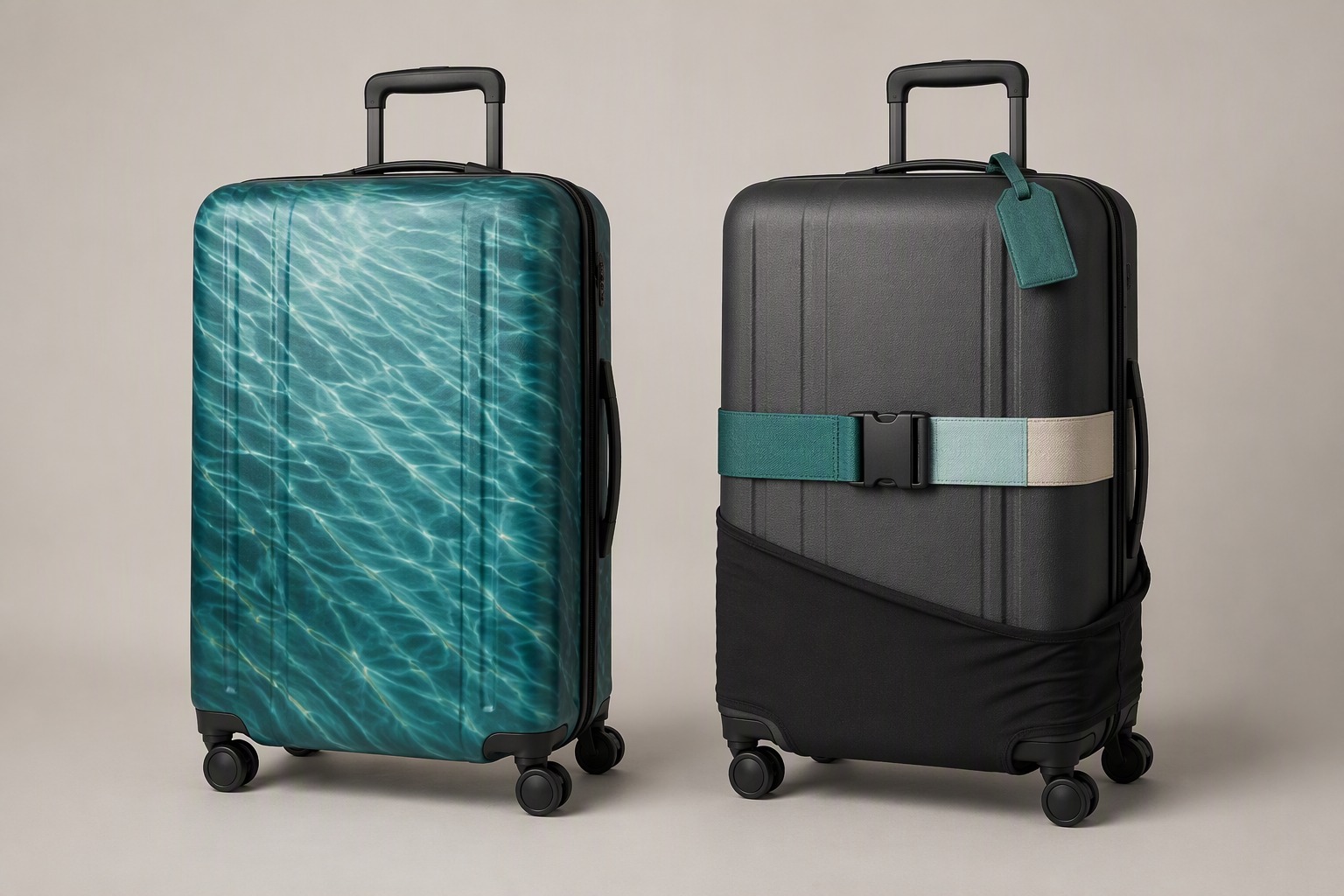
: Reversible pieces change the outside of the bag without altering the shell; a factory finish is part of the shell.
Family color coding
One person, one color is the simplest identification rule that survives a busy trip. Each traveler scans for their own color and stops sorting through tags — it removes reading, which is exactly what you cannot do while bags are moving.
Give children a say in their own color. Ownership makes them more likely to check "is this mine?" and less likely to grab the nearest similar case. If two travelers want the same color, split them across the reversible layer — different strap colors on the same shell color — so the family system stays unambiguous while the underlying cases stay standard.
Privacy: identify without oversharing
An identification system should be readable by you and uninformative to everyone else. Do not place your full name, home address, or mobile number in an externally visible spot, where any passerby can read it at leisure. Prefer a surname plus an email address, or initials alone, or a design that is visually unique to you.
Anything more specific belongs inside. Keep a full itinerary, a second contact number, and any detailed contact card in an interior pocket, available to whoever needs it if the bag is separated from you and not displayed to everyone standing nearby. Small text outside, complete information inside.
Choosing a method at a glance
| Personalization method | Visibility on the carousel | Reversible? | Effect on repairs and after-sales | Best for |
| Solid light color | High, but shared with many travelers | No — factory shell | Part of the shell | A clean look; accepts visible wear |
| Solid dark color | Low; hardest to pick out | No — factory shell | Part of the shell | Hiding scuffs; a formal look |
| Large-scale high-contrast pattern | Highest; the eye locks on fast | No — factory shell | Part of the shell | Fast self-identification |
| Fine stripe or groove finish | Moderate; reads almost solid at distance | No — factory shell | Part of the shell | Texture without a loud print |
| Name or initials on the shell | Very high when large and high-contrast | No — factory shell | Part of the shell | Frequent flyers wanting an exact match |
| Luggage tag | Moderate; hidden behind other bags | Yes | Separate piece; shell untouched | First-time personalizers |
| Cover or shell wrap | High; covers a large area | Yes | Separate piece; shell untouched | Renters, resellers |
| Stickers and decals | Moderate to high | Yes | Separate piece; shell untouched | Kids and frequent restylers |
| Strap or band | Moderate; marks the handle | Yes | Separate piece; shell untouched | Family coding; group travel |
Building the permanent layer with us
CLK Luggage is a B2B luggage manufacturer in Jiangxi, China, working on OEM and ODM projects. Appearance color and pattern customization is one of the categories we produce, using the same finish families described above. Made-to-order runs start at MOQ 200 pieces, light customization takes 30–45 days, and non-custom orders run 30 days. If you are deciding where a custom look belongs in your line, start with custom luggage costs and MOQ, compare surfaces in luggage materials and finishes compared, then review the workflow in how our OEM/ODM process works.
FAQ
What is the fastest way to make my suitcase recognizable?
Use a large, high-contrast pattern or a bold reversible accessory placed high on the case; size and contrast at a distance matter more than the specific color. Fine textures and small tags read as neutral from across a carousel and help much less.
Are printed patterns on the shell permanent?
Yes — large-area colors and patterns are applied at the factory and become part of the shell, so they cannot be removed or swapped later. Tags, covers, stickers, and straps are added after production and can be changed or removed at any time.
Does a printed pattern affect the warranty?
A printed finish sits on the shell, so it is part of the product itself, while a removable piece such as a tag or cover never touches the shell or hardware. Warranty terms themselves are set by the brand or retailer selling the bag, so confirm the specific policy for the item you are buying before you commit to a full-shell print.
Should I choose a light or a dark color?
It depends on which problem you would rather live with: light colors are easier to spot but show scuffs and dirt sooner, while dark colors resist visible wear but give you the least help at the carousel. If you want both, choose a mid-tone or a high-contrast pattern that mixes light and dark areas.
What is the minimum order quantity for custom luggage, and how long does it take?
Our made-to-order runs start at MOQ 200 pieces. Light customization takes 30–45 days, and non-custom orders run 30 days.
What should I put on an externally visible luggage tag?
Keep it minimal: a surname with an email address, or initials alone, rather than your full name, home address, or phone number. Store complete contact details and your itinerary inside the case instead.
The short version
Good identification is a small system, not a single purchase. Pick the biggest, highest-contrast mark you are comfortable with, let the reversible layer do the daily work of telling your case apart from everyone else's, keep full personal details inside the bag, and if you are producing luggage rather than packing it, decide early which layer belongs to the product and which belongs to the traveler.