
The best suitcase organization system is not a bigger case or a longer packing list. It is three decisions you make once and repeat on every trip: build the interior from fixed modules instead of loose stacking, separate wet from dry and dirty from clean with physical barriers, and use compression only on soft goods. Across our own product line, a carry-on in the 20-inch class holds anywhere from about 31 L to 40 L depending on the model, and a 24-inch class case ranges from roughly 35 L to 43 L — about 8 L between two cases that both say "24 inch." Capacity is a property of the case. Usability is the result of how you organize it.
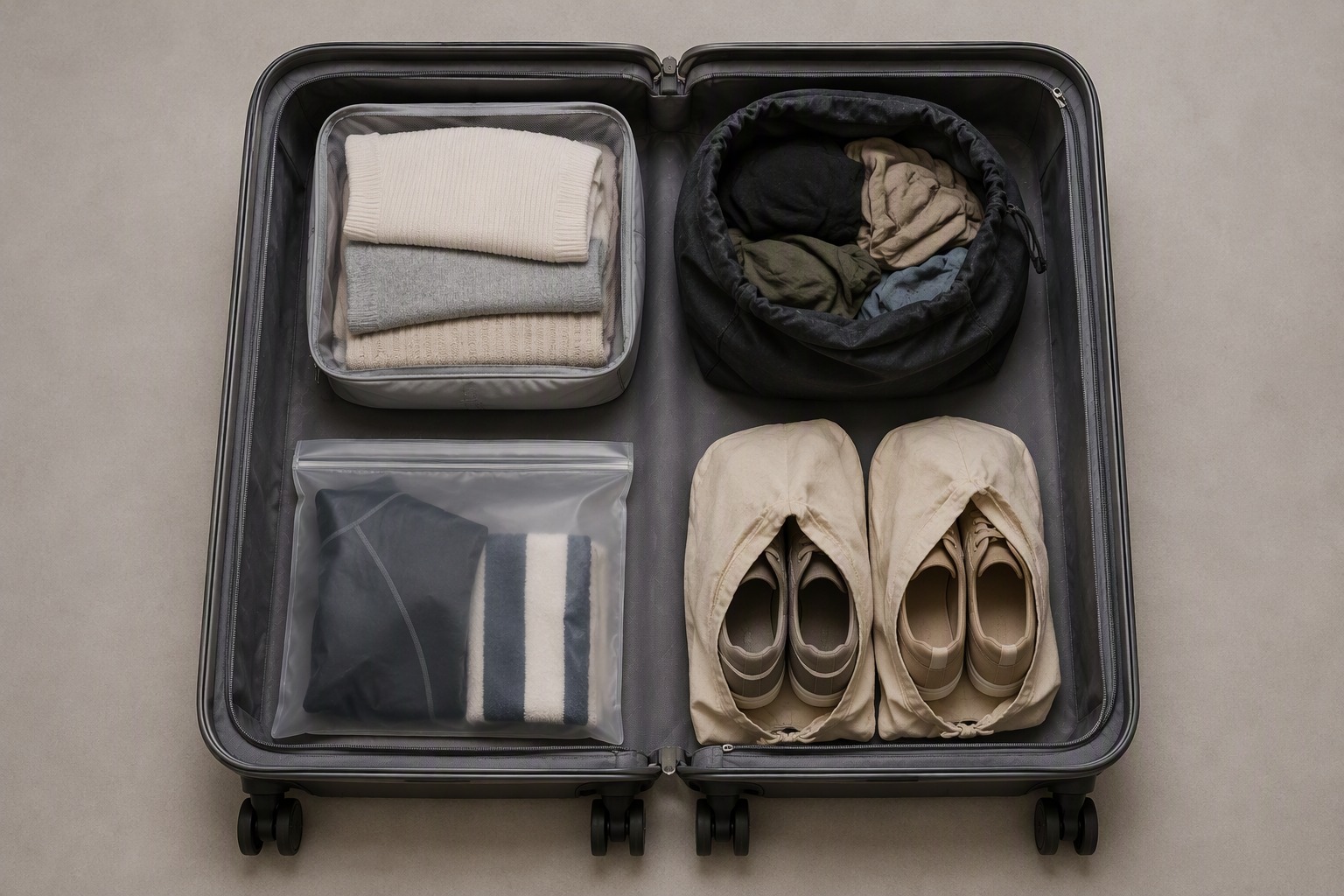
: Four zones, four containers. The dividers matter more than the brand.
Why a bigger case is not the answer
The instinct when packing fails is to size up. Usually that just moves the same problem into more space: a bigger interior lets loose clothing spread, shift, and collapse into itself. What you notice at the destination is not a shortage of liters but the cost of re-sorting one undifferentiated mass at every stop.
Interior volume is not fixed within a size class either. In our own line, the 20-inch class runs from about 31 L in a PC set to 40 L in a front-opening carry-on, the 24-inch class from about 35 L to 43 L, and the 28-inch class from about 38 L to 50 L. Those spreads come from geometry — shell curvature, wheel housings, handle channels, lid depth — not marketing. A deeper lid gives a flatter, more usable block of space; a shallow lid over a bulging base gives the same figure on paper and a far more awkward interior. The better question, then, is not whether to buy a larger case but whether the one you own is organized.
If you are still choosing the case itself, how to compare interiors rather than labels covers how to compare interiors rather than labels.
The four zones every case should have
Divide the interior before you pack, not while you pack. Every case, from a carry-on to a 28-inch check-in, should resolve into four zones, each with its own container — the container keeps the zone intact once the case is closed, tilted, and lifted onto a belt.
| Zone | What goes in it | What contains it | Why it works |
| Clean clothes | Tops, trousers, dresses, knitwear, underwear | Packing cubes, one per garment family; a flat folder for collared shirts | Cubes turn soft clothing into a rigid block that stops migrating and re-wrinkling |
| Dirty clothes | Worn items, anything damp with sweat | A dedicated dirty-laundry cube or lined stuff sack | The barrier is the point: dirty items stop touching clean ones the moment they come off |
| Wet items and swimwear | Swimsuits, rash guards, wet towels, leaky toiletries | A fully sealed, water-resistant pouch, kept apart from the dirty cube | Sealing differs from separating: a wet swimsuit in a mesh cube wets everything below it |
| Shoes | Sneakers, dress shoes, sandals | Individual shoe bags or a rigid base layer under the cubes | The dirtiest, heaviest objects in the case; they belong at the wheel end |
Two details matter more than the table: the wet zone must be sealable, not merely separate, and the clean zone should be split one cube per garment family so a module can be lifted out on its own.
Compression: what it actually does
Compression removes air. It does not remove fabric. That distinction explains the confusion around compression bags and tells you exactly when to use one.
Air is a large part of what looks like clothing in a loosely packed case, because knitwear, down, fleece, and other lofted fabrics are mostly structured air held in place by fibers. Press that air out and the bundle genuinely gets smaller. Here compression does real work and is the right tool: puffer layers, knit sweaters, fleece, synthetic insulation, soft sleepwear.
For denim, tightly woven cotton, structured blazers, and anything you want to arrive with a sharp line, compression barely changes volume and adds a serious cost. Dense woven fabric has almost no air to remove, so you flatten something that springs back, and you set hard creases that cure during travel. There is a second cost: the tighter a module is packed, the harder it is to open, identify, and repack. Over-compressed bundles become bricks at the bottom of the case — the thing you were trying to avoid.
So the rule is narrow and boring, which is why it works. Compress soft, lofted items. Fold dense and structured items flat. Never compress just to make a case close: that is how zippers, hinges, and shell corners get stressed, and how a case that should last years quietly stops latching.
Packing cubes vs full-seal bags vs vacuum bags
These containers get lumped together, but they solve different problems — which is why people conclude that organizers do not work.
Packing cubes are structural. They convert loose clothing into modules with defined edges, which keeps the interior stable and lets you unpack one zone at a time. They are the default for a mixed trip with clean clothes, dirty clothes, and shoes, and the only category that works when you reach into the case repeatedly.
Full-seal bags — roll-down or zip-sealed, non-vacuum — are barriers. Their value is containment: wet swimwear away from dry clothes, dirty items away from clean ones, a leaking bottle away from fabric. They compress a little as a side effect, but containment is the point.
Vacuum bags remove the most air and demand the most from the trip. They need a pump or a vacuum, and once sealed they are rigid slabs that are hard to reshape around wheels and handles. They suit one scenario: a long stay with seasonal bulky layers, where you pack once at home and unpack once at the destination. They are a poor choice for a multi-city trip or anything you open mid-journey, and the wrong container for dense woven clothing.
For most travelers the workable combination is cubes for the clean zone, a seal bag for the wet zone, a dirty-laundry bag, and shoe bags. Vacuum bags are an optional extra, not the foundation.
Build one system per traveler
The four zones exist for everyone. The module count changes with the traveler, and that is the useful variable — not the case size.
Solo short trip. One or two cubes of clean clothes, a dirty cube, and shoes at the base. Everything stays reachable, which is what makes a carry-on feel generous even at the lower end of its capacity range.
Business travel. Keep the garment zone separate and rigid. Collared shirts fold flat in a folder or wide flat cube, jackets layer across the top of the cube block, and shoes go into individual bags so a polished pair does not scuff. Dirty items get their own cube from day one, because a business trip usually involves a hotel change.
Family. This one needs redundancy rather than cleverness. Give each person their own cubes in their own color, and keep a shared seal bag for wet items from the pool or the beach. One person's cube is the boundary; when it is full, that person is packed.
Will it fit your 20", 24", 28"?
Module combinations scale with the size class. The volumes below are the ranges in our own line, not an industry standard.
| Traveler and trip | 20-inch class (31 L – 40 L) | 24-inch class (35 L – 43 L) | 28-inch class (38 L – 50 L) |
| Solo, short trip | Clean cube, shoes at base, dirty cube, small seal bag | Same plus a second clean cube | Not needed — a 24-inch case covers it |
| Business | Flat shirt module, shoes bagged, dirty cube | Shirt module plus a garment layer across the top | Shirt module, jacket layer, shoe base, dirty cube |
| Family, one case per person | Each person: one cube, shoes bagged | Each person: two cubes, one dirty cube | Shared seal bag plus per-person modules |
A 20-inch case and a 28-inch case are not the same system scaled up. The carry-on rewards one compact rigid block; the large case rewards layers and separation, because a deep interior is where loose items drift. For the vocabulary of comparing interiors, see shell material comparison.
Hotel arrival: pack so you unpack once
Pack so the modules themselves go into the drawer. If a cube can be lifted out and placed on a shelf as a unit, arrival takes a minute and nothing is re-sorted or lost. That is why the dirty zone must be its own container: it goes straight back into the case at the end of the stay.
Layer the case so the modules you need first are on top — toiletries pouch and wet bag nearest the lid, clean cubes in the middle, shoes and anything heavy at the wheel end. Then close it without forcing the zipper: if it will not shut under light pressure, a module is in the wrong place or the bundle is too thick.
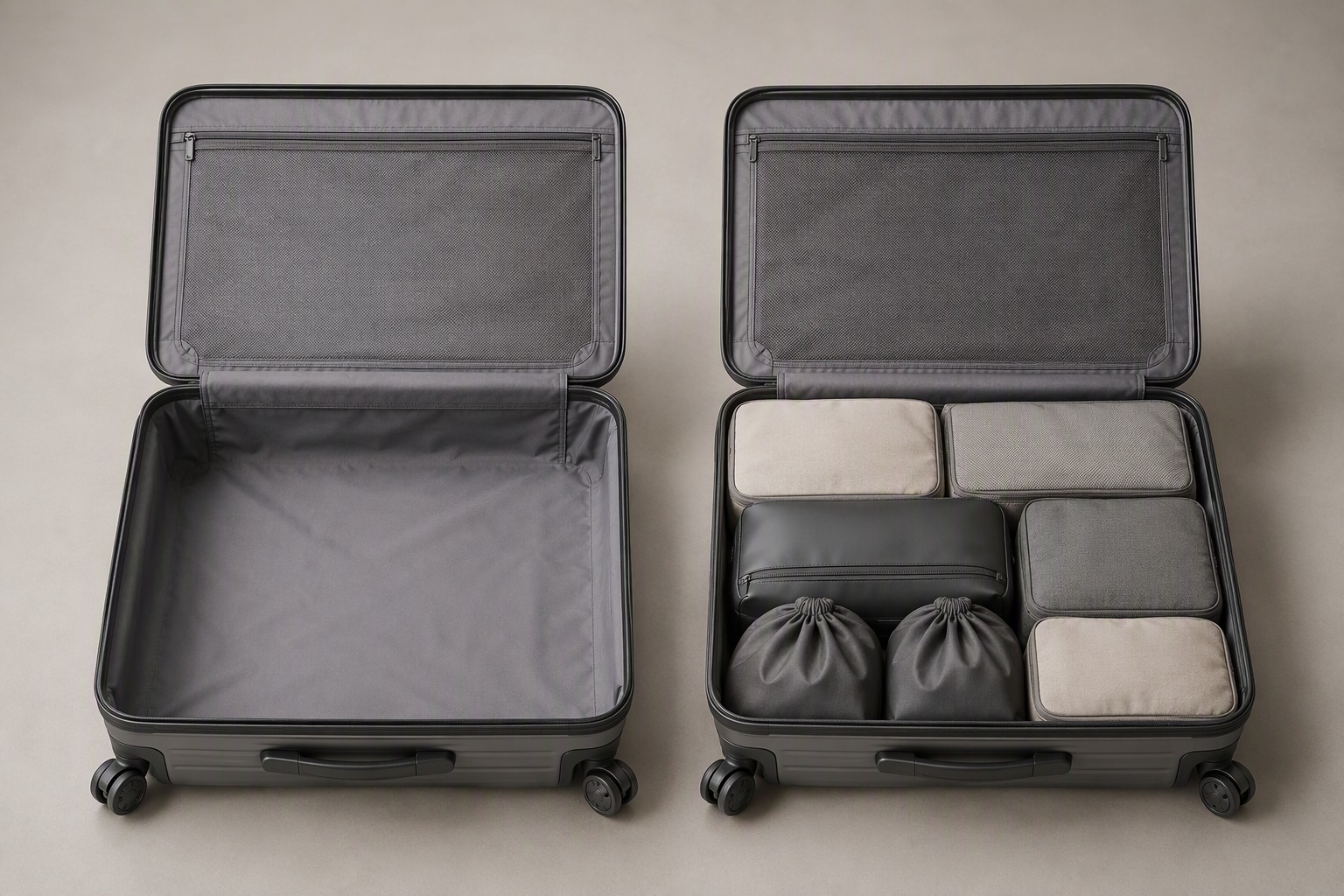
: Same case, same volume — only the interior is organized differently.
Frequently asked questions
Do compression bags really save space?
They genuinely squeeze out air, but how much space that saves varies by fabric, so no fixed percentage holds — the figures in circulation contradict each other and trace back to secondhand sources.
Should I use packing cubes or vacuum bags?
Use cubes as the foundation, and vacuum bags only for the bulky-layers trip where you pack once and unpack once.
How do I keep dirty clothes away from clean clothes?
Give dirty items their own container from day one, plus a separate sealable pouch for wet items. Separation then happens automatically when you repack.
Is a bigger suitcase easier to pack?
No — it is easier to pack loosely, which is a different problem. Two cases in the same size class can hold noticeably different usable volume.
Where should shoes go?
At the wheel end of the case, in individual bags. They are the heaviest and dirtiest items, so keeping them at the structural base protects the clean zone and the case's shape.
What is the minimum setup for a carry-on?
One clean cube, one dirty cube, a sealable pouch for wet or leaking items, and a shoe bag.
Why we care about what happens after the zipper closes
We build suitcases, so we are biased toward one question: once your things are inside, does the case work for you? Interior layout, lid depth, handle channels, wheel housings, and repairable hardware decide how much of the capacity you can use and how long the case keeps doing its job. Our notes on repairable suitcases and spare parts cover that.
Whichever case you fly with, keep the principle rather than our numbers: carry-on size and weight limits are set by the airline, not by the brand, so always check your airline's own page for the rule that applies to your ticket. Everything else — the zones, the barriers, and the compression rule — is in your hands.