
Buy carry-on luggage for the airlines you actually use. If most trips are within the United States, a bag that uses your regular carrier's allowance can give you useful packing space. If you often change airlines or travel abroad, a more compact bag may be easier to use across your itinerary.
The deciding factor is the suitcase's full external size and packed weight, rather than its "domestic" or "international" label. Before replacing your current bag, check whether it already meets the rules for your next trip. You may not need another suitcase.
Domestic vs International Carry-On: What Changes?
American Airlines publishes a maximum carry-on size of 22 × 14 × 9 inches, including handles and wheels. That is a useful U.S. shopping reference, but international flights do not share one equivalent limit. Some carriers allow a wider case; others restrict depth or impose a weight allowance that changes what you can pack.
| What to compare | Domestic-oriented carry-on | International-oriented carry-on |
|---|---|---|
| Design emphasis | Often prioritizes packing space for U.S. travel | Often uses a shorter profile for selected overseas carriers |
| Size check | Compare all three external measurements | Check width and depth as carefully as height |
| Weight check | Read your carrier's policy | Factor empty weight into any published allowance |
| Best starting point | Your usual airline | Every airline operating your planned flights |
An international model can be shorter but wider than a domestic model. It may therefore suit one airline and exceed another's width limit. A smaller height alone does not establish compatibility.
Check Three Things Before Choosing a luggage
1. The airline operating each flight
Check the airline flying the aircraft, including connecting flights. A ticket purchased through one carrier may include a segment operated by another. Record the applicable dimensions for every leg, then compare each measurement separately.
For example, if one flight permits 56 × 36 × 23 cm and another permits 55 × 40 × 20 cm, a bag measuring 55 × 36 × 20 cm satisfies both sets of dimensional limits. A 55 × 40 × 20 cm bag exceeds the first carrier's width allowance. Weight and fare conditions still need checking.
2. What your fare includes
A suitcase can meet the size limit without being included in your ticket. Ryanair's standard allowance includes a 40 × 30 × 20 cm personal bag stored under the seat. Its Priority & 2 Cabin Bags option adds a 55 × 40 × 20 cm cabin bag weighing up to 10 kg.
Buying a compact suitcase does not turn it into an included underseat bag. Check your booking before deciding that a different case will solve the problem.
3. The packed weight
Singapore Airlines allows one cabin bag up to 7 kg in Economy and Premium Economy, with combined length, width and height no greater than 115 cm. This illustrates why a roomy case is not always the most practical choice: you can run out of weight allowance before filling it.
For a broader comparison, use our airline carry-on size and weight guide, then confirm your booking against the operating airline's current policy.
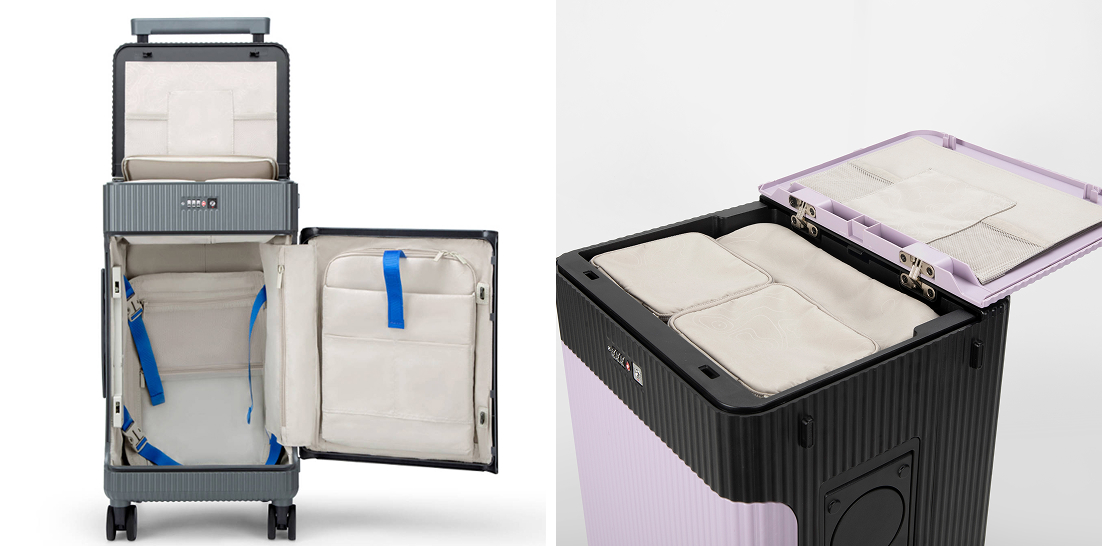
Which Size Suits Your Travel Routine?
Mostly U.S. domestic trips
If you regularly use the same airline, choose a bag within its published external dimensions. Extra packing space may help with a second pair of shoes or work clothes, provided the loaded bag still qualifies.
Do not choose a taller case solely because it fitted an overhead bin on a previous trip. American Airlines notes that some airports and aircraft have additional restrictions.
Occasional international trips
Start with your existing suitcase. Measure it, check your overseas carriers and consider whether adjusting your packing is enough. An international destination alone does not establish a different baggage allowance.
If your bag exceeds a connecting carrier's limit, compare the cost and inconvenience of checking it with buying a second, smaller case. An occasional trip may not justify replacing a bag that otherwise suits you.
Frequent international travel
Build your shortlist around the airlines you use repeatedly. Compare their height, width, depth and weight limits rather than shopping for an undefined "global size."
A compact, lighter case is worth considering when several regular routes impose lower allowances. If a rare journey has unusually restrictive rules, borrowing a bag or checking luggage may make more sense than reducing capacity for every other trip.
Empty Weight Can Matter More Than Extra Space
Use this calculation before comparing features: Available weight for belongings = cabin-bag allowance minus empty suitcase weight.
Under a 7 kg allowance, a 1.8 kg case leaves 5.2 kg for belongings; a 3.75 kg case leaves 3.25 kg. The difference is 1.95 kg, approximately 28% of the total allowance. These are calculations using the published weights of the CLK models below, not independent travel tests.
Now add your laptop, toiletries, shoes and chargers. A heavier case can still suit your priorities, but it requires a different packing budget. Check whether your airline weighs personal items separately or combines them with cabin baggage.
For business trips, weigh your equipment first. Then decide how much suitcase weight you can accommodate. Our carry-on buying guide covers materials and construction in more detail.
Two CLK Carry-On Designs to Compare
PC Ultra-Light Litchi Texture Luggage
The CLK 8838-CQ lists a 53 × 32 × 19 cm size and 1.8 kg net weight. Its textured polycarbonate shell, TPU wheels and external aluminum trolley make it a relevant option when keeping case weight down is a priority. Logo, color and other customization options are available.
Aluminum Carry-On luggage set
The 20-inch case in the CLK 1125 luggage set lists 55 × 36 × 19 cm and 3.75 kg in its specification table. It combines an aluminum-magnesium shell, aluminum frame, reinforced corners and double spinner wheels. Consider this design when the metal construction matters more to you than minimizing empty weight.
Before ordering either model, confirm the finished configuration's overall dimensions, including wheels and handles, and request its current weight. Published model sizes should not replace sample verification.
Measure Your Bag the Way the Airline Will
Before buying or packing, follow these steps:
- Retract the telescopic handle and close the expansion panel.
- Measure the full height, including wheels and fixed handles.
- Measure the widest and deepest points, including feet and pockets.
- Pack your actual travel items and repeat the measurements.
- Weigh the loaded bag and compare it with each flight's allowance.
Soft pockets can bulge, and expansion can increase depth. A bag that qualifies empty may exceed the limit after packing. Do not assume that unused width compensates for excess height unless the airline explicitly uses a combined measurement rule.
Keep a small allowance for souvenirs if you plan to return with more than you take. Leaving room inside does not help if the return flight's weight limit is already reached.
What If Your Current Bag Misses a Limit?
Identify what fails before spending money. If the problem is packed weight, remove duplicate shoes, reduce toiletries or choose lighter equipment. If a soft pocket causes excess depth, repack and measure again. A fixed wheel or rigid shell that exceeds a dimensional limit needs a different solution.
Compare the options for the whole itinerary: use a smaller bag, purchase the appropriate baggage allowance or check your suitcase. Buying extra allowance does not necessarily increase the permitted cabin dimensions, so read what the option actually includes.
For a short trip, an underseat bag may be enough. For a longer journey with equipment or bulky clothing, checked luggage may be more comfortable than forcing everything into a compact case. Choose around the trip rather than treating carry-on-only travel as a requirement.
For Brands: Start Customization With the Travel Requirements
If you are selecting luggage for a retail collection or corporate program, define the target routes before choosing features. Your specification should include maximum external dimensions, empty weight, expansion measurements and intended airline allowances.
Then discuss shell material, wheels, handles, compartments and branding. Each structural choice affects the finished product. Ask for a configured sample and check it packed, rather than approving only a drawing or shell measurement.
Explore CLK's OEM and ODM luggage services to discuss a design, or review the sample and manufacturing process before requesting a quotation.
FAQ
Q1. Can I use a domestic carry-on internationally?
A: Yes, if its overall dimensions, packed weight and your fare's allowance meet every applicable flight's requirements. Its product label does not determine eligibility.
Q2. Is an international carry-on suitable for U.S. flights?
A: It can be, but check width and depth. A shorter international model may be wider than your U.S. carrier permits.
Q3. Is a 22-inch suitcase automatically a carry-on?
A: No. Height is only one measurement, and the advertised figure may describe the body rather than the whole suitcase. Compare all external dimensions.
Q4. Should I buy an expandable carry-on?
A: It can be useful when you expect to check the bag on some journeys. Confirm both closed and expanded dimensions before relying on it for cabin travel.
Q5. Can a correctly sized bag still be checked at the gate?
A: Yes. Aircraft restrictions and available cabin space can affect storage. Meeting published limits reduces sizing problems but does not reserve overhead space.
Choose the case that accommodates your usual trips, rather than the largest one labeled carry-on. Browse CLK's carry-on collection and request the specifications that match your route, weight budget and customization needs.
Conclusion
Choose domestic carry-on luggage if you mainly fly within the U.S. and its dimensions match your regular airline. For frequent overseas trips or mixed carriers, consider an international carry-on with a size and empty weight suited to every flight. Check wheels, handles, packed weight and fare allowances before buying. Comparing domestic vs international carry-on options comes down to usable packing space and airline compatibility. CLK offers designs for different travel and customization needs.