
The short answer: do not leave the baggage claim area. If your bag does not come off the belt, go straight to your airline's baggage service desk inside the terminal and insist that a mishandled baggage report is created before you exit the arrivals hall. Keep your claim tags, boarding pass and receipts, and photograph the bag on the spot. The rules behind that advice are not vague: an airline may limit its liability on a domestic U.S. itinerary to $4,700 per passenger, and on most international journeys the Montreal Convention caps baggage liability at 1,519 SDR (approximately US$2,175) per passenger. A bag is also not declared lost on day one — most airlines wait 5 to 14 days.
Don't leave the baggage claim area yet
Conclusion first: report the problem where it happened, in person, before you leave the terminal. A claim opened at the belt is documented; a claim opened by phone two days later is an argument.
- If the bag arrives opened, unlocked or visibly damaged, check the contents immediately — open it at the belt and report missing or broken items before you leave the airport.
- Ask for the report to be generated, not discussed. "We'll look into it" is not a report; a report has a number.
- Write down the date and time of every conversation, plus the name and phone number of the person you spoke with.
- Ask for the barcode identification tag for every bag, and keep your claim tags until the bags are back in your hands.
- Put your name, phone number and email on the bag tag. Nearly all delayed bags are eventually found and returned; the label is how the airline locates you.
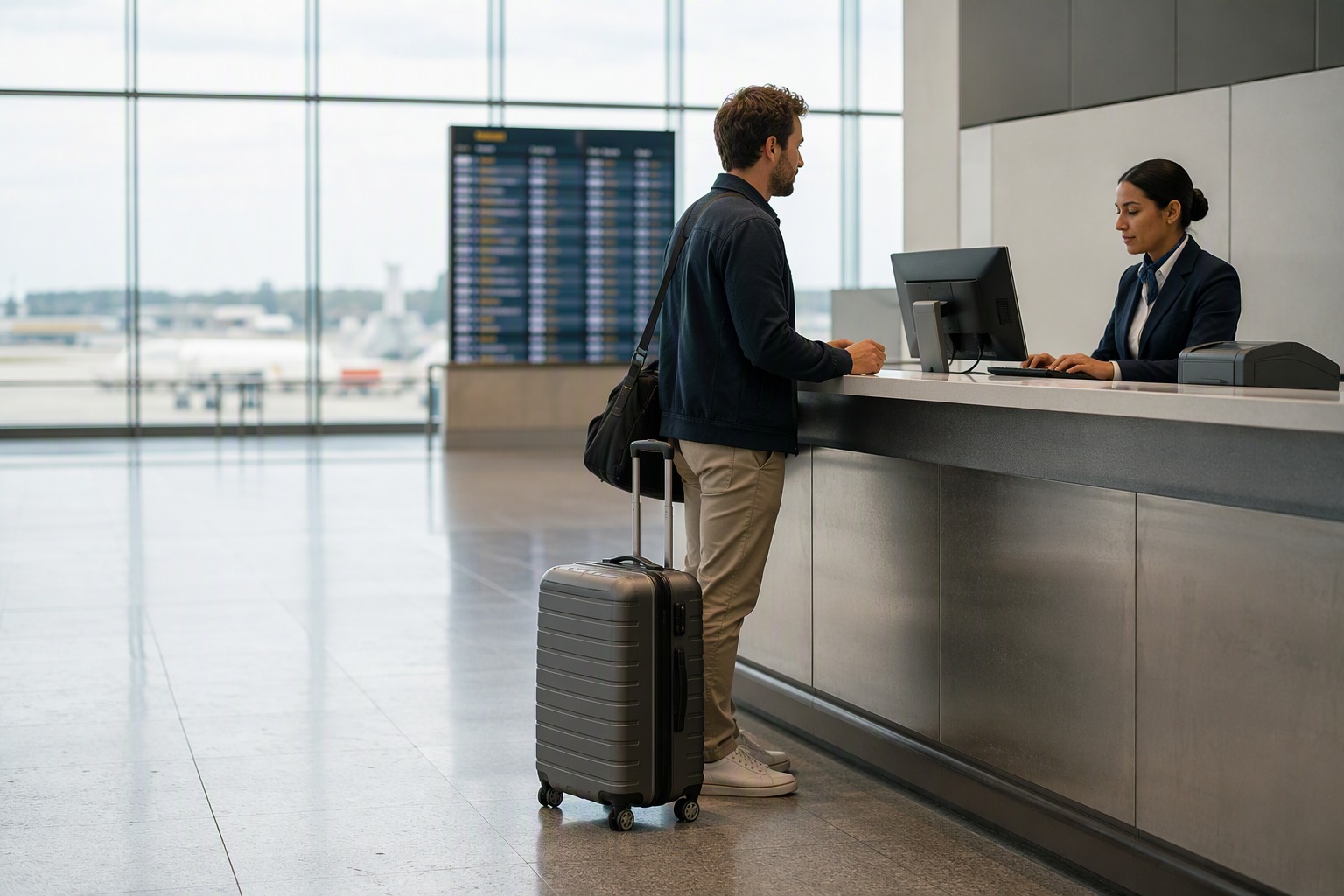
: The report is the case. Open it inside the terminal, before you leave the airport.
What to say at the airline's baggage service desk
Conclusion first: you are opening a file, not asking for a favor.
State the flight number and date, the bag tag numbers, and the problem, then work down this list.
- Ask for a copy of the report and the file reference number.
- Ask how interim expenses are reimbursed — the reasonable, verifiable, actual costs the delay caused, within the liability limit.
- Ask about the checked bag fee if you paid to check the bag.
- Ask what the deadline is for your claim. Deadlines are strict and run from the report date, so get it in writing.
- Ask for a status contact, and use it. You are expected to stay in touch while the file is open.
Keep these documents and photos
Conclusion first: build one folder on your phone the same day. A claim is only as strong as the evidence attached to it.
- Boarding passes, e-ticket receipt, and the baggage claim tags for every bag on the ticket.
- The mishandled baggage report and its reference number.
- The checked bag fee receipt, plus receipts for everything the delay forced you to buy.
- Photos of the bag from several angles, taken as soon as the problem appeared and before any repair attempt.
- A written contents list with realistic values — compensation uses depreciated value.

: The evidence pack: tags, report, receipts, photos — collected the same day, not the same week.
Delayed: what you can claim while you wait
Conclusion first: the airline must locate the bag, and it must pay for reasonable, verifiable, actual expenses the delay caused, up to its liability limit.
- "Reasonable, verifiable, actual" is the test. Buy what you genuinely need and keep every receipt.
- Airlines may not invent their own flat daily ceiling. A policy that pays a flat $50 per day regardless of what the delay cost is not permitted.
- Keep the airline in the loop. Locating the bag is the airline's job; staying reachable is yours.
- Paid checked bag, significantly delayed? You are entitled to a refund of that bag fee — submit the mishandled baggage report, and in most cases the refund follows automatically.
- "Significantly delayed" means: domestic — not delivered within 12 hours after arrival; international — not delivered within 15 hours when the flight was 12 hours or shorter, or within 30 hours when it was longer. The clock stops when you pick the bag up at the arrival airport, or when it is delivered to the location you and the airline agreed on.
Damaged: wheels, handles, and what airlines cannot exclude
Conclusion first: an airline must repair or compensate damage that happens while your bag is under its control — not damage that was already there, and not damage caused by how you packed.
- Repair or compensation, within the limit. If repair is impossible, the airline negotiates based on the bag's value and depreciation.
- Some parts cannot be excluded. Wheels, handles, straps and similar components are protected; normal wear and tear is the narrow exception, and a part that failed is not wear and tear.
- Exclusion clauses depend on the itinerary. Fragile goods, electronics, cash, perishables and valuables: on a domestic itinerary the airline may refuse to pay; on an international itinerary, including its domestic legs, an airline that accepted the item for transport must accept liability for it, declared or not.
- Strip garment bags before checking them — straps and hooks catch in baggage-handling machinery.
- Claim fast. Damage claims carry strict deadlines; confirm the exact window in the contract of carriage.
our repair and spare parts guide
Lost: when a bag is officially lost
Conclusion first: a bag becomes officially lost on the airline's timetable, not yours — most airlines declare a bag lost only after 5 to 14 days.
- Why the window varies: airline policy, a domestic or international itinerary, and how many carriers are on the ticket.
- Once declared lost, the airline compensates contents at depreciated value within the limit, refunds the checked bag fee, and may ask for receipts for high-value items.
- If it refuses, an airline that unreasonably keeps a bag in limbo can face DOT enforcement.
- Until then it is a delayed bag — keep the report open and keep the receipts.
Domestic vs international: the limits are different
Conclusion first: the most common mistake in a baggage claim is reading one rule as a global rule. Identify the regime your ticket falls under first.
- Domestic U.S. itineraries. DOT rules let the airline limit liability to $4,700 per passenger. Airlines may pay more voluntarily, but they are not required to.
- International itineraries. Most are governed by the Montreal Convention, which caps baggage liability at 1,519 SDR (about US$2,175) per passenger. That figure is reviewed and adjusted for inflation by ICAO every 5 years.
- A small number of round-trip itineraries to and from the United States are not covered by the Montreal Convention and may fall under the older Warsaw Convention.
- Mobility aids are their own case. On domestic flights, liability for a damaged mobility aid is the original purchase price of the device and is not subject to the baggage cap; international carriage is subject to the treaty limit. A device disassembled for transport must be returned in its original condition, and damage must be repaired.
| Situation | Who is responsible | What you do | Documents you need |
| Bag delayed | Airline must locate and return it and reimburse reasonable, verifiable, actual interim expenses within the limit | File the mishandled baggage report before leaving the airport | Report reference number, claim tags, boarding pass, receipts |
| Bag damaged | Airline repairs or compensates damage that happened under its control; wheels, handles, straps cannot be excluded | Report it inside the airport and file the claim before any repair attempt | Photos of the damage, claim tags, report reference number, purchase receipt |
| Bag declared lost | Airline compensates contents at depreciated value within the limit ($4,700 domestic / 1,519 SDR international) and refunds the checked bag fee | Follow up until the airline declares the bag lost | Contents list, receipts for high-value items, report reference number |
| Paid bag significantly delayed | Airline refunds the checked bag fee | Submit the mishandled baggage report; the refund usually follows automatically | Baggage fee receipt, report reference number |
| Mobility aid damaged | Domestic: original purchase price, outside the baggage cap. International: treaty limit | Report immediately; require repair or return in original condition | Photos, report reference number, proof of purchase |
Damage and delay claims also carry strict, short deadlines set out in the airline's contract of carriage. Confirm the current wording there and on the official DOT pages rather than trusting a summary.
Pre-flight: the evidence pack to prepare before you fly
Conclusion first: most of the pain in a baggage claim is decided before the flight, not after it.
- Label the bag properly. A tag with your name, phone number and email does more for recovery than anything else here.
- Do not check in at the last minute. If you make the flight but your bag does not, or you miss the check-in cutoff, the airline may not be responsible for what follows.
- Itinerary structure changes your risk. From safest to riskiest: a direct flight, a stop where you stay on the same plane, a connection within the same airline, then a connection between two different airlines.
- Never check what the trip cannot continue without. Small valuables, medication, keys, passport, tickets, business documents, irreplaceable items, fragile items such as glasses, and anything perishable belong in your carry-on.
- Photograph the bag, closed and open, before you leave home — the cleanest answer to a later "pre-existing damage" defense.
carry-on and checked-baggage size rules
Frequently asked questions
How long should I wait before reporting a missing bag?
Zero waiting. Report it inside the baggage claim area, before you leave the airport, and insist on a printed report.
How much can an airline be made to pay for a bag?
The ceiling depends on the itinerary: $4,700 per passenger on a domestic U.S. itinerary, and 1,519 SDR (roughly US$2,175) per passenger under the Montreal Convention on most international itineraries.
Can the airline refuse to pay because the bag was not locked, or because I packed electronics?
It depends on the itinerary. On a domestic itinerary the airline may refuse items its contract excludes — fragile goods, electronics, cash, perishables, valuables. On an international itinerary, an airline that accepted the item for transport must accept liability, even if you did not declare it. Wheels, handles and straps cannot be excluded.
The airline quoted a fixed daily amount for my delay. Is that all I get?
No. Airlines may not set their own flat daily cap. You claim the reasonable, verifiable, actual expenses the delay caused, up to the liability limit.
How long before my bag counts as officially lost?
Most airlines declare a bag lost after 5 to 14 days; the window varies by airline, by itinerary type, and by how many carriers are on the ticket.
Do I get the checked bag fee back?
Yes, if a paid checked bag is declared lost or significantly delayed. Submit the mishandled baggage report; in most cases the refund follows automatically.
We build suitcases, so we look closely at how they fail in the baggage system: shells that crack around a wheel housing, handles that pull out of their mounts, zippers that split under load. That is why this guide exists. Running the claim is the traveler's job; building a bag that gives the claim less to argue about is ours. If you want the next step after a bad experience at the carousel, it is choosing more carefully next time: how shell materials compare on durability.